
New Construction / International / V6 /
02 - Health and wellbeing
Information correct as of 19thOctober 2026. Please see kb.breeam.com for the latest compliance information.
Acceptable deviations – ISO 7730:2005 category B - KBCN1714
Acceptable deviations from category II thermal modelling criteria can be made in accordance with CEN 16798-2:2019 Anne E, only when the thermal comfort assessment uses CEN 16798 to demonstrate compliance. Where this is the case, up to a 6% deviation based on yearly occupied hours can be accepted when demonstrating compliance.
Note: this KBCN no longer allows the deviations to be used for ISO 7730:2005. However, for assessments where the assessor has advised the project team based on the original KBCN, prior to this update, this will be honoured if you provide evidence of this in your assessment.
KBCN wording 16 Jan 2025 - 10 Jul 2025:
~ Acceptable deviations from the ISO 7730:2005 category B criteria thermal modelling criteria can be made in accordance with CEN 16798-2:2019 Annex E. Up to a 6 % deviation based on yearly occupied hours can be accepted when demonstrating compliance ~
10 Jul 2025 - KBCN updated following further review of relevant standards
Accreditation – sampling and testing laboratories - KBCN1337
Analysis / testing laboratory
NC 2016 or newer: Where an organisation used for the analysis of indoor air or emissions from building products is not accredited to ISO/IEC 17025, the organisation must be accredited, either by a national accreditation body, or by a member of any one of the following accreditation groups:
European Cooperation for Accreditation
International Accreditation Forum
International Laboratory Accreditation Cooperation
The accreditation must specifically cover the analysis of indoor air or emissions from building products.
Other schemes: Accreditation to ISO/IEC 17025 is
not required in the criteria. However, this KBCN has been applied to encourage a consistent approach towards accreditation.
Accreditation by a national or internationally recognised organisation helps to ensure rigorous, consistent and reliable testing results.
Sampling organisation
If another organisation carries out sampling on behalf of the analysis / testing laboratory, this organisation does not need to be accredited to the above. However, they must provide a brief report justifying:
- The sampling methodology used.
- Appropriate environmental conditions during the sampling.
- The number and location of samples taken.
This report is provided to the BREEAM assessor and submitted as supporting evidence for this issue.
31-Oct-2022 Wording clarified. Scheme applicability updated.
10-Oct-2022 Title amended for clarity. Scheme applicability updated.
24-May-2022 Updated to differentiate between sampling and analysis requirements.
07-May-2021 Added clarification regarding alternative qualifications.
10-May-2021 Updated scheme applicability.
Adaptability for a projected climate change scenario – Winter conditions - KBCN1715
Where future climate change scenario projections in winter indicates a higher temperature and, therefore, more thermally comfortable climate compared to the current winter temperatures, it can be assumed that the winter conditions within the climate change scenario are met based on the thermal modelling of current winter conditions. Justification must be provided for each project confirming that the future winter conditions will be met with the current heating system.
In a warming climate the heating system needs to be sized for the beginning of its lifespan, whereas the cooling systems need to be sized for the end of their life span (Ref: CIBSE TM55: 2014)
Air-conditioned spaces - KBCN00035
Air-conditioned spaces are assessed to ensure appropriate thermal comfort levels are achieved. Cooling capacity should be sufficient to comply with the requirements of CIBSE Guide A, however providing sufficient space to install additional capacity to meet the requirements at a later date in line with projected climate change scenarios is also acceptable.
In addition, if it can be demonstrated that the air-conditioning system can achieve the thermal comfort criteria in accordance with CIBSE Guide A, Table 1.5, thermal modelling does not need to be carried out. The “time out of range” (TOR) metric should be reported as 0%.
Applicability – industrial operational areas - KBCN1342
The aim of this issue is to encourage a healthy internal environment. For the operational areas of industrial buildings, the internal environment is dictated by health and safety requirements. This means that the BREEAM requirements should not be made applicable to them, and so the operational areas can be ignored in the assessment of Hea 02.
10-Oct-2022 - Title amended to align with standard KBCN naming format for clarity and consistency. Made applicable to UK and International NC V6.
Applicability – retail asset with no office areas - KBCN0531
The compliance note regarding industrial and retail areas incorrectly suggests that the minimising sources of air pollution credits are not applicable to retail areas with no associated offices. These credits do apply to retail sales areas, although they are excluded for operational areas in industrial buildings.
The 'potential for natural ventilation' credit is not applicable for retail sales areas, as it applies only to office areas. Therefore, where a retail building does not contain any office, this credit is not applicable.
While the requirements apply to permanently or semi-permanently occupied offices, small admin areas, which are only used occasionally can be excluded.
This also applies to shell only and shell and core new build projects, where it can be demonstrated that no office spaces will be provided as part of the fit-out.
The online tool will award the credit by default in both issue 1.0 of the INC 2016 scheme and up to issue 1.4 of the IRFO 2015 scheme. When assessing against INC 2016 2.0 and V6, the online tool will instead filter this credit out.
22-Oct-2022 Title amended to align with standard KBCN naming format for clarity and consistency. Made applicable to International NC V6.
11-Sep-2018 Clarification added in relation to spaces that are used occasionally, and shell only/shell and core new build projects.
15-Sep-2017 Clarification added on the procedure for making the 'potential for natural ventilation' credit N/A on the online tool. Technical manual to be updated accordingly in next re-issue.
Applying internal partition sound insulation criteria to internal doors - KBCN0665
Where sound insulation criteria apply to internal partitions the calculations do need to include any doors which are part of the wall in question.
While sound insulation performance of a typical door will be lower than for a typical wall, with careful design, specification and detailing, this can be overcome.
Appropriate project stage to appoint a suitably qualified acoustician - KBCN0256
BREEAM requires that a suitably qualified acoustician is appointed at an appropriate stage of the project, so as to ensure that early design advice on criteria of pre-requisition is met. The aim is to ensure that costly amendments to building designs are not made as a result of late appointment of the acoustician. Ultimately, it is for the assessor to determine at what stage of the project is deemed to be appropriate for this appointment to have taken place given the project specific circumstances and procurement type.
Areas in the public domain - KBCN0587
Where areas within the site boundary will be public domain after construction, and the design/specification has been determined by the local authority/statutory body/planning permission etc, they can be excluded from the assessment of the 'Safe Access' criteria. Evidence would be required to demonstrate that this was the case.
Where the client/design team do not have control of the design of these areas, the development should not be prevented from achieving the credit.
Assessing thermal comfort – Residential buildings - KBCN1408
CIBSE TM59 can be used to demonstrate compliance with the thermal comfort requirements for residential buildings, instead of ISO 7730:2005.
This is to recognise the most up to date methodology relating to the assessment of homes.
26 Jan 2025 - Updated to apply to multi-residential buildings (long-term stay) and scheme applicability extended to account for this.
BREEAM Daylighting – Alternative methods - KBCN1821
Within the BREEAM daylight criteria, there are two detailed calculation options of either using the average daylight factor method or average and minimum daylight illuminance method.
The use of the standards within the table below, can now be used as approved alternative calculation methods. The performance requirement must be met in line with either the standard or exemplary criteria as set out in the table below:
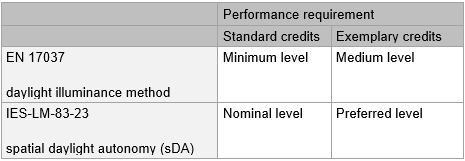
To use either the EN 17037 or IES-LM-83-23 option, the methodology within Guidance Note 50 must be followed. In addition, the minimum percentage area to comply, dependant on the building type and space type, must be met in accordance with the criteria within the relevant BREEAM issue. To calculate the percentage of assessed area that complies, follow
KBCN0471 or
KBCN1081.
Example:
A school using the International New Construction V6 scheme, has used the IES-LM-83-23 sDA method to calculate the daylight performance. The nominal level is achieved in all occupied spaces. The minimum area to comply is set at 80% as per table 10 and 12. As 100% of occupied spaces meet the nominal level, 2 credits can be met.
Cyclist safe access - KBCN0188
Safe access for cyclists must be via a compliant cycle lane, unless it is demonstrated that it would be impractical to cycle for a short distance between the site entrance and cycle storage. For example, where a gate, door or barrier forces the cyclist to dismount and walk for a short distance to access the cycle storage and it would be impractical for cyclists to re-mount.
Where it is not practical to provide compliant cycle lane from the entrance to the cycle storage, the safety of cyclists and pedestrians must be maintained.
21/02/2020 Re-worded to clarify the intent
Dedicated cycle paths in the absence of cycle facilities - KBCN00039
Safe cycle access needs to be provided even if there are no dedicated cycle facilities. The dedicated cycle paths will generally need to be provided to the main entrance(s) of the building along routes likely to be used by cyclists through the site. The design team are required to determine what is required to satisfy the intent of the criteria.
Cycle access and cyclists' facilities are assessed independently of each other. Building users may cycle even if the building does not have cycle storage facilities and so safe and secure access to and from the building must be provided.
Definition of concourse - KBCN0386
A concourse is an open area within or in front of a public building which is used primarily for circulation, short term waiting, or incidental interaction, analogous to the concourse of a train station. It should not be considered occupied space.
Definition: cafe, canteen, catering kitchen, restaurants, bars - KBCN0691
For the purposes of the Acoustic Performance credit:
Informal cafés or canteen areas, catering kitchens are generally services provided by an organisation such as a college, factory, or company for it's students or staff.
Restaurants are places where food are served to the public on the premises. Compared to the examples above, restaurants can be independent and not ancillary, as per the BREEAM definition and scope.
Bars are establishment where soft drink/alcohol and sometimes other refreshments are served. They might be on their own or ancillary to other functions, e.g. hotels.
Emissions from construction products – Re-used and reclaimed products - KBCN1869
The Emissions from construction products criteria in BREEAM are intended to apply to newly manufactured construction products and materials.
Where a construction product can be robustly identified as previously used and is re-used or reclaimed, it may be considered as outside the scope of the Emissions from construction products criteria.
However, any new coatings, finishes, adhesives, sealants, or other chemical treatments applied for the product’s installation must be considered and assessed separately, where relevant.
Emissions from products – Building materials for M&E purposes - KBCN1740
All M&E materials are excluded from VOC assessment requirements. However, from V7 onward, while finished M&E products may be excluded, all on-site applications of paints, coatings, adhesives and sealants used for M&E purposes must be included in VOC assessments under their relevant material categories.
02 July 2025 - Inclusion of duct insulation removed
Emissions from products – earlier versions of AgBB standard - KBCN0655
Guidance Note GN22 lists the standard AgBB (2015) as a recognised scheme for emissions from building products for pre-December 2015 launched BREEAM schemes.
Previous versions of the AgBB scheme are not listed as recognised schemes because earlier versions of AgBB did not include any requirement for the testing of Formaldehyde.
If an earlier version AgBB has been used, further evidence will be required to provide additional information on the required Formaldehyde testing.
10-Oct-2022 - Title amended to align with standard KBCN naming format for clarity and consistency. Made applicable to International NC V6.
Emissions from products – EU CLP Regulation and Category 1A/B carcinogen emission limits - KBCN1280
The European Regulation (EC) No.1272/2008 on classification, labelling and packaging of substances and mixtures (‘the CLP Regulation’ or ‘CLP’) applies to all EU Member States.
CLP requires manufacturers, importers, downstream users and distributors to communicate the identified hazards of a substance or mixture to the other parties in the supply chain, including to consumers. The regulation requires products with hazardous properties to be labelled in accordance with CLP before being placed on the market. CLP requires products containing any ingredients that have been classified as Category 1A and 1B carcinogens to be labelled as carcinogenic.
Therefore, with respect to the BREEAM Category 1A and 1B carcinogens emission limit criteria, for products marketed in EU Member States, if a product’s safety information (e.g. safety data sheet) or a manufacturer’s declaration confirms that that the product does not need to be labelled as a Category 1A or 1B carcinogen in accordance with CLP, then this information would be an acceptable form of evidence for demonstrating compliance with the criteria.
10-Oct-2022 - Title amended to align with standard KBCN naming format for clarity and consistency. Made applicable to International NC V6.
Emissions from products – installations manufactured off-site - KBCN0137
Internal finishes to installations manufactured off-site such as elevators need to be assessed for the emissions from products criteria.
The specification of internal finishes (regardless of whether they are installed on site or in the factory) will impact on VOC emissions. By specifying low VOC finishes, design teams will be encouraging manufacturers to consider the environmental impacts of their products.
10-Oct-2022 - Title amended to align with standard KBCN naming format for clarity and consistency. Made applicable to UK and International NC V6.
Emissions from products – manufacturers’ calculations for paints and varnishes - KBCN0452
Manufacturers' calculations of VOC content, based on the constituent ingredients, can be used to demonstrate compliance with the testing requirement for paints and varnishes.
10-Oct-2022 - Title amended to align with standard KBCN naming format for clarity and consistency. Scheme applicability updated.
Emissions from products – scope of assessment - KBCN0212
General
This issue covers any product installed or applied inside the inner surface of the building’s infiltration, vapour or waterproof membrane.
Where this membrane is not present, it applies to the inside of the building envelope’s interior-facing thermal insulation layer.
Only products that are installed or applied in parts of the building where their emissions are likely to affect indoor air quality need to be assessed.
Paints and coatings
Any decorative paints and varnishes that occupants are exposed to should be assessed.
This is likely to include paints and coatings applied to walls, ceilings, floors, doors, etc.
Whole products
A finish applied to a product in the factory is assessed as a whole product, and not separately as a paint or coating.
For instance, a wood panel has a finish applied in the factory. The whole panel, including all the elements that make up that panel, would need to comply with the requirements set for wood panel products in this issue.
The finished product as a whole must meet the performance requirements / emission limits set in the manual.
11-Oct-2022 - Title amended for clarity and consistency. Content merged with KBCN871.
10-Oct-2022 - Wording simplified. Scheme applicability updated.
16-Jun-2017 - Title and general principle amended to extend the applicability of the KBCN to all finishes. Paints specified for specialist applications covered in KBCN0872.
Emissions from products – specialist paints and coatings - KBCN0872
Where a paint or coating falls within:
- A category in Annex II of the EU Directive 2004/42/CE or,
- A category in the relevant product emission table of the technical manual,
then the paint or coating must be assessed.
Specialist paints and coatings are exempted from meeting the VOC content and emission limits where there are no alternative products available that can perform the function, and still meet the emission limits.
This must be clearly evidenced.
02-Oct-2025 Reference to 'VOC content' added and KBCN applied to INC V7 to clarify CN2.1
27-Oct-2022 Wording clarified. New compliance principle added from UKNC V6.
10-Oct-2022 Title amended for clarity. Scheme applicability updated.
13-Mar-2020 KBCN amended to clarify exceptions and applicability.
16-Jun-2017 Content merged with KBCN0212.
Emissions from products – testing to ISO 16000-10 - KBCN1134
Results of testing to ISO 16000-10 can be considered compliant with the relevant testing requirements of the emissions from construction products credit where the product manufacturer can demonstrate the results generated by testing to ISO 16000-10 correlate to results that would be achieved using EN 16516 or ISO 16000-9.
This is because EN 16516 classifies ISO 16000-10 as an ‘indirect method’, which means “any simplified, screening, secondary, derived or alternative method. An indirect method can be applied if it provides a result that is comparable to or that correlates with the result of the reference method under the conditions applied. The validity of the correlation with the reference method is limited to the field of application for which it has been established.”
11-Oct-2022 - Title amended for clarity and consistency. Scheme applicability updated.
Emissions from products – Recognition of carcinogen classifications from non-EU schemes - KBCN1879
Where BREEAM material emission criteria reference Category 1A and Category 1B carcinogens, these classifications are based on the EU CLP Regulation.
However, where a certification scheme or testing body does not work directly to EU CLP classifications, other recognised authoritative carcinogen classification systems may be accepted as an alternative basis for carcinogen identification. This can include:
• International Agency for Research on Cancer (IARC)
• California Office of Environmental Health Hazard Assessment (OEHHA)
Erratum – Applicability of ‘Internal lighting’ and ‘zoning and occupant control’ criteria to Residential buildings - KBCN0978
These criteria, i.e. 7 to 9 and 11 to 13, are not applicable to Residential buildings.
Technical manual to be updated in the next reissue.
Exemplary level criteria – not all product categories specified - KBCN0636
The assessment of exemplary level criteria assumes that every product category is specified. It awards credit(s) based on the number of product categories that meet the exemplary levels.
Where the assessment does not contain every product category,
all product categories must meet the exemplary level requirements.
[accordion]
[accordion_block title="1 exemplary credit"]
Exemplary credit requirement: 3 out of 4 product types meet the exemplary requirements.
An assessment has only specified 3 product types in total. To achieve the credit, all product types must meet the exemplary criteria.
[/accordion_block]
[accordion_block title="2 exemplary credits"]
Exemplary credit requirement:
- 1 exemplary credit: 4 out of 5 product types meet the exemplary requirements.
- 2 exemplary credits: 5 out of 5 product types meet the exemplary requirements.
An assessment has only specified 3 product types in total.
- No exemplary credits are awarded if 2 out of 3 product types meet the requirements.
- 2 exemplary credits are awarded if 3 out of 3 product types meet the requirements.
[/accordion_block]
[/accordion]
19-Oct-2022 - Wording and title clarified. Scheme applicability updated. Scenario added.
External lighting – architectural façade lighting - KBCN0650
Architectural facade (or other decorative) lighting which does not provide users with lighting to perform tasks outdoors does not need to be included in the assessment of external lighting.
This Issue seeks to ensure that lighting levels are appropriate for tasks which building users will be undertaking outdoors.
External lighting – High frequency ballasts - KBCN0278
The requirement for all fluorescent and compact fluorescent lamps to be fitted with high frequency ballasts does not apply to external lighting.
Formaldehyde E1 emissions requirements – Untreated solid wood - KBCN1881
Testing for formaldehyde is not required for untreated solid wood where no formaldehyde containing binders, resins, adhesives, coatings, or chemical treatments have been used in the processing or manufacture.
In such cases, a formaldehyde emissions test report is not required. However, the assessor must obtain confirmation from the manufacturer/supplier that:
- the product is solid, untreated timber
- no formaldehyde has been used as described above
Future thermal comfort – mechanical ventilation, mixed mode and limited comfort cooling - KBCN1877
Where a building or space incorporates mechanical ventilation systems, including mixed-mode strategies, the selection of future weather files for thermal comfort assessment should be based on the expected service life of the systems installed. This includes systems providing mechanical ventilation, with or without limited comfort cooling, and mixed-mode spaces where natural ventilation is supplemented by mechanical systems within the same space.
For the purposes of this guidance, ‘mechanical ventilation with limited comfort cooling’ refers to systems that may provide some degree of cooling or air tempering but are not designed to fully maintain internal conditions to defined air-conditioned setpoints throughout occupied hours.
Although these systems do not provide full air conditioning, their presence influences internal environmental conditions and overheating risk. As their performance is dependent on mechanical components with defined service lifespans, the future thermal comfort assessment should be aligned with the expected lifespan of these systems (typically 15 years), rather than the overall building lifespan.
For schemes where free‑running buildings are assessed using a longer lifespan for future climate scenarios, a shorter system lifespan should be used where mechanical systems are present
Glare control – use of tinted windows - KBCN0862
Solar control or 'tinted' glazing could potentially support the attainment of this requirement. However, the assessor must be satisfied and provide evidence to demonstrate that the particular glazing type, when used on the assessed building for a given location, is meeting this overarching aim of preventing disabling glare. It should be noted that whilst certain types of glazing, such as low emissivity glazing, may be slightly tinted, they may not necessarily be effective in reducing disabling glare.
For facades receiving direct sunlight, tinted windows alone are unlikely to be sufficient in the majority of situations.
Glare control – Venetian blinds - KBCN1867
Venetian blinds must demonstrably meet the openness factor and transmittance value for blinds, where specified within a BREEAM manual. If the specification data for Venetian blinds is not available, evidence of the two points below can be provided instead:
1. The blind slats can be fully closed and overlap so there are no gaps between them.
2. The slat material clearly transmits no light, for example solid and opaque plastic, wood or metal.
If the slat material is not solid and opaque, and is for example, perforated or made from woven fabric, the openness and transmittance values must be demonstrated in line with the criteria.
Glare control for roof lights - KBCN0319
Where roof lights are present, they must be considered when demonstrating that the glare control strategy provides adequate control/measures for minimising glare in that space.
All sources of glare need to be considered when designing out the potential for disabling glare.
Glare control in residential areas - KBCN00040
Glare control criteria apply to building areas such as study bedrooms or facility management offices, where work or study will be carried out and where glare would hinder such activities. It does not apply to other residential areas.
Glare control – Modelling - KBCN1800
The ‘Glare control’ criteria do not require a specific methodology to be used to identify areas at risk of glare, and in most situations, a simple solar path analysis would be suitable. Alternatively, detailed hourly modelling methods, such as DGP and ASE, may be more appropriate. However, in either case, compliance cannot be assumed.
Regardless of the methodology used, the modelling must be supported by robust reporting to demonstrate that each aspect of the criteria has been met.
GN06 Indoor air quality plans - KBCN0618
Latest version: v2.3, July 2026
Guidance Note 6 (GN06) provides guidance to assessors and project teams regarding the content and rigour of an Indoor Air Quality Plan (IAQP) as required by the indoor air quality criteria in BREEAM New Construction and BREEAM Refurbishment and Fit Out.
It should not be interpreted as BREEAM criteria. It is intended to provide assessors and project teams with further, flexible information and guidance regarding the rigour, content, and tasks of an IAQP.
Download Guidance Note 6
View all Guidance Notes on BREEAM Projects (licensed assessors only)
15-Jul-2026 - Updated version released (v2.3)
GN22 Recognised schemes for emissions from construction products - KBCN0719
Latest version: v3.2, July 2026
Within the Health and Wellbeing category of several BREEAM schemes, credits are awarded for specifying materials that minimise emissions from building products of formaldehyde and volatile organic compounds (VOCs). The criteria involve meeting emission level performance requirements in accordance with compliant performance and testing standards.
Guidance Note 22 (GN22) lists schemes that show equivalent or better performance than the current BREEAM and HQM criteria and therefore can be used to demonstrate compliance with the criteria. This document should be read in conjunction with the relevant assessment issue guidance provided in the appropriate BREEAM or HQM technical manual.
The guidance note contains two tables:
- Table 1 is for use with BREEAM schemes that were first released before December 2015.
- Table 2 is for use with BREEAM (and HQM) schemes that were first released from December 2015 onwards (post-November 2015).
Download Guidance Note 22
View all Guidance Notes on BREEAM Projects (licensed assessors only)
Applying for inclusion in GN22
The list of approved schemes is based on those which have made a successful application to BREEAM. As such, there may be other operational schemes that could potentially be recognised.
To be considered for inclusion, the scheme operator must complete an application form, providing full details of the scheme, and submit this to BRE Global for technical approval. A flat rate charge is payable to cover the costs of administering and reviewing the application. GN22 will be updated following the approval of any schemes via this process.
The application form (BF1648) provides full details of the application process, and licensed BREEAM assessors can request a copy by submitting a technical query using the
webform. Other parties may request a copy by contacting:
breeam@bregroup.com
15-Jul-2026 - Release of GN22 3.2
25-Mar-2026 - Release of GN22 3.1
30-Oct-2025 - Applicable to HQM V6 and UKNCR V6.1
25-Sep-2025 - Updated to provide details of the approval process and title updated.
30-Jan-2025 - Release of GN22 3.0
30-Sep-2024 - Release of GN22 2.9
01-Feb-2024 - Release of GN22 2.8
31-Jan-2023 - Release of GN22 2.7
10-Oct-2022 - This KBCN merged with KBCN0646. Title amended to align with standard KBCN naming format for clarity and consistency. Made applicable to UK and International NC V6.
25-Jan-2019 - Link to Guidance Note updated
12-Mar-2018 - Link to Guidance Note updated
Hazards – Applicability of the issue - KBCN0541
The applicability of issue Hea 07 Hazard is related to the risk of natural hazards in the country, or region, in which the project is situated. This is reflected in the environmental weightings.
The approach to this issue changes according to the country and to the scheme.
BREEAM International New Construction 2013 and BREEAM International Refurbishment and Fit Out 2015
This issue should not be taken into consideration for countries which have a weighting for this issue equal or lower than 1%. The suggested threshold to start considering this credit is more than 1%.
Where no risks are identified in the risk assessment report, this issue will not be applicable, even if the related weighting has a value higher than 1%. Thus before undertaking a risk assessment, it is recommended to investigate if the area might be subject to the natural hazards listed in the technical manual.
BREEAM International New Construction 2016
Countries with no or very low risk, have a weighting of 0% for this issue. Thus, according to the BREEAM scoring and rating system, this issue should not be considered. The suggested threshold to start considering this credit is more than 0%.
Where no risks are identified in the risk assessment report, this issue will not be applicable, even if the related weighting has a value higher than 0%. Thus before undertaking a risk assessment, it is recommended to investigate if the area might be subject to the natural hazards listed in the technical manual.
High frequency ballasts - KBCN0284
Fluorescent and compact fluorescent lamps are the only types of lighting where high frequency ballasts are required. The requirement does not apply to any other type of lamps.
Inclusive and accessible design (non-residential only) - KBCN0863
Shared and accessible facilities are applicable where relevant.
For office, retail and industrial buildings, if there are no spaces suitable to be shared with members of the public or community, this can be justified and the ‘inclusive and accessible design’ credit met by demonstrating compliance with the other criteria.
Commercial buildings are unlikely to provide spaces that are suitable to be shared with members of the public/community.
Indoor air quality plan – later consideration - KBCN1544
Where BREEAM has been engaged at a later stage in the project (for instance, at the beginning of a Post-Construction Assessment) the IAQ plan must still be produced.
The late stage plan must clearly identify opportunities to improve indoor air quality that:
- Were lost during design and construction.
- Remain before hand-over and occupation.
- Can be applied during operation.
The plan is focused on decisions and actions that can still be practically carried out.
The indoor air quality plan is an on-going consideration that extends into the operational life of the asset.
Indoor air quality plan – scope - KBCN0294
Where possible, the indoor air quality plan must cover all items in the criteria. This means the plan must be completed for:
- Situations where BREEAM has been engaged later in the project (see KBCN1544).
- Shell only / shell and core projects - the plan must be completed for the scope of works being assessed.
- Refurbishment projects with a limited scope of works.
Within these requirements, there is flexibility for the design team to use their professional judgement to determine what is appropriate to meet the criteria.
Any exclusions must be clearly evidenced and justified.
As the basis for effective asset management, the indoor air quality plan must be written in a consistent and comprehensive manner. The report must address relevant aspects as fully as possible within the scope of the development.
11-Oct-2022 Title updated for clarity. Wording clarified. Content merged with KBCN0556. Reference to KBCN1544 added. Scheme applicability updated.
Instant hot / cold drinking water systems - KBCN0136
In principle it is acceptable to use instant hot / cold water systems (for example zip taps) to meet the drinking water requirement, provided that their use is appropriate for the building type and user profile.
Internal lighting levels where computer screens are used - KBCN0283
For areas where computer screens are regularly used projects can specify 300 lux, as referenced in CIBSE Lighting Guide 7, rather than the levels prescribed in the standard EN 12464:2011.
07 Dec 2021 Applicability to BIU V6 Commercial confirmed.
Natural ventilation – use of CIBSE TM52 - KBCN0935
For a naturally ventilated building, it is acceptable for the thermal comfort limits and calculation methodology in CIBSE TM52: The Limits of Thermal Comfort: Avoiding Overheating in European Buildings to be used in place of ISO 7730:2005.
BREEAM recognises that adaptive comfort models can provide more appropriate thermal comfort limits for naturally ventilated buildings.
Occupant control – BMS and degree of control - KBCN0175
A Building Management System controlled set point with local override controls limited to a set range would satisfy the occupant control requirement so long as the temperature range available to building users is confirmed as appropriate for the building type and user profile.
Occupant control – spaces requiring user controls - KBCN0170
This guidance is intended to clarify the types of area for which user controls are required or would be considered beneficial.
Zoning is required in all areas of the asset where specified in the assessment criteria. Please refer to the specific requirements of the applicable BREEAM standard to interpret this guidance appropriately.
User controls required
Spaces where users are expected to have independent control over their environment.
- Owned spaces: small rooms for a few people.
For instance, cellular offices, owned spaces in residential assets.
- Temporarily owned spaces: where occupants expect to operate the environmental controls while they are there.
For instance, meeting rooms and hotel bedrooms.
- Shared spaces.
For instance, multi-occupied areas such as open-plan offices or workshops.
User controls not required
Spaces where users are not expected to have independent control over their environment.
- Managed spaces: where environmental control is expected to be centrally managed.
For instance, atria, circulation areas, concourses, entrance halls, function halls, restaurants, libraries, and shops.
- Occasionally visited spaces.
For instance, storerooms, bookstacks in libraries, aisles of warehouses, toilets.
14-Dec-2022 - KBCN applicability updated to include BIU. Wording clarified, and amended for compatibility with BIU criteria.
PMV and PPD reporting for mixed mode ventilation buildings - KBCN0632
When assessing buildings where both naturally ventilated and air conditioned spaces are included, reporting the PMV and PPD indices is required.
Pods or privacy booths used as workstations – Impact on view out - KBCN1697
Provided the space or room itself is compliant based on a more traditional furniture arrangement, the enclosure of workstations in booths or pods can be disregarded when considering compliance with the ‘View out’ criteria.
Post-construction measurement – formaldehyde / VOC levels exceed limits - KBCN0258
If the measured formaldehyde / VOC concentrations were above the prescribed limits, the appropriate remedial action must be taken, as described in the IAQ Plan. The criterion requires confirmation of 'the measures that have or will be undertaken' however it does not specifically address re-testing. We would expect, however that the IAQ Plan should outline what remedial measures are appropriate depending upon the severity and type of the non-compliance with prescribed limits. Such measures may include re-testing as a matter of 'best practice'.
Where levels are found to exceed these limits, the project team confirms the measures that have, or will be undertaken in accordance with the IAQ plan, to reduce the TVOC and formaldehyde levels to within the above limits.
10-Oct-2022 - Title amended to align with standard KBCN naming format for clarity and consistency. Made applicable to International NC V6.
Post-construction measurement – sampling methodology and KPIs - KBCN0380
When testing for VOCs post-completion and pre-occupancy, a representative sample of the building needs to be carried out. Each sample TVOC and formaldehyde measurement needs to achieve the threshold levels individually, either in the initial testing or after remedial measures have been implemented. This ensures that all tested areas of the building are below the limits, and that areas of non-compliance are not ‘averaged out’.
'When providing KPI test results for air quality post-construction / pre-occupancy within scoring and reporting tool, where the limits are exceeded and remediation and re-testing are carried out, the figure should be an average for the whole building post-remediation, as this is the key figure that reflects the building at its certified state'.
Where testing is not a requirement of the IAQ Plan and this is not carried out, the original testing figures should be entered and the assessment report should provide details of the remediation measures undertaken to reduce these to within the prescribed limits.
10-Oct-2022 Title amended to align with standard KBCN naming format for clarity and consistency. Scheme applicability updated.
06-Dec-2017 Amended to account for situations where re-testing is not required by the IAQ Plan.
Potential for natural ventilation – areas exempted - KBCN0806
For projects where the majority of a building's occupied spaces will meet the criteria to achieve the potential for natural ventilation credit, but a relatively small area will not comply due to functional requirements of the space, (e.g. a lecture theatre), the credit can be awarded where this approach can be justified.
The intention is to encourage the design of buildings where a strategy of (potential for) natural ventilation has been implemented as far as practically possible, given functional constraints.
Potential for natural ventilation – mechanically ventilated and mixed mode assets - KBCN1533
Scope of KBCN
This KBCN clarifies the associated compliance note for this credit.
- NC 2011 & 2013 - No CN, but the principle of this KBCN can be applied.
- NC 2014 v5.0 - CN 3.1
- INC 2016 v2.0 and INC V6 - CN 3.11
- RFO 2014 v2.0 - CN 7
- RFO 2015 v1.4 - CN 5.2
Clarification
Mechanically ventilated and mixed mode assets can potentially achieve the 'potential for natural ventilation' credit by:
- Meeting the relevant criteria for room depth and glazing area OR, where this is not possible:
- Show through modelling that the building has the potential to be ventilated entirely via a natural ventilation strategy.
For 2. the second paragraph of the CN allows flexibility in demonstrating adaptability to an entirely natural ventilation strategy.
An asset can allow for mechanical ventilation for ≤ 5% of its annual operating hours to boost ventilation rates, and (for this credit) can still be considered to be a fully naturally ventilated strategy.
≤ 5% mechanical ventilation rule
The focus of this credit is to demonstrate future adaptability to introduce fresh air into the asset for occupant comfort, so this requirement relates only to mechanical ventilation. Active heating / cooling is not considered.
≤ 5% is a weighted average over all of the asset's occupied spaces. The basis for the weighting will be determined by the modelling software used.
Scope and time scale of modelling
The modelling covers all occupied spaces. Where relevant, exclusions are allowed - see related KBCNs for details.
The modelling period is one year, during the asset's operating hours.
The modelling must be based on a plausible scenario that is realistic. This means that:
- Potential changes can be practically and reasonably achieved by future occupants.
For example, the adaptation strategy must not require new or modified openings in the building envelope or include significant or disruptive changes to the internal layout.
- The changes do not compromise the intended function or operation of the asset.
- For speculative assets, a realistic notional layout can be used. See KBCN0408.
- The modelling assumption does not need to factor in climate change.
The aim of the credit is prove the validity of a future naturally ventilated scenario - if and when this is carried out is outside the scope of the certification.
Potential for natural ventilation – shell only assessments - KBCN0408
Where compliance depends on a speculative layout which is unknown, it is the responsibility of the design team to demonstrate that it is feasible for a future tenant to achieve compliance in the relevant areas via the use of a notional layout.
This ensures that the shell allows the potential for compliance, and if this can be demonstrated the credit may be awarded.
Potential for natural ventilation – use of doors to comply - KBCN0690
Doors can only be used to demonstrate potential for natural ventilation where:
- They can be used to achieve at least 2 levels of ventilation control as required in the criteria AND,
- Using them does not cause accessibility or security issues during asset operation.
In all cases, the use of doors must be clearly and robustly justified by the Assessor.
19-Oct-2022 - Wording clarified. Scheme applicability updated.
Prerequisite – Users with special hearing and communication needs - KBCN0969
Intent
Criterion 1c ensures that the suitably qualified acoustician has influenced the design of the asset to:
- Meet the acoustic requirements of users with special hearing and communication needs.
- Ensure that accessible acoustic design is considered where this is not adequately covered by local legislation.
What this should cover will depend on the asset type and expected users.
Asset users
The UK Department for Education document BB93
Acoustic design of schools: performance standards building bulletin 93 (February 2015) defines users with special hearing or communication needs as those with any of the following:
- Speech, language and communication difficulties.
- Visual impairments.
- Fluctuating hearing impairments caused by conductive hearing loss.
- Attention deficit hyperactivity disorder (ADHD).
- An auditory processing disorder or difficulty.
- Being on the autistic spectrum.
This list is not exhaustive, and the suitably qualified acoustician must consider typical asset users, along with the other points a-d when giving early design advice regarding room layout, sound insulation and reverberation times.
Accessibility features
The principles of accessible design are universal and could be applied in a wide range of assets. Additional features that could be relevant to accessible acoustic design include, but are not limited to:
- Designation of quiet zones.
- Hearing assistive technologies.
- Induction loop systems.
- White noise machines.
- Infrared and FM systems to provide direct audio to individuals with special hearing needs.
- Noise barriers.
The suitably qualified acoustician must use their professional judgement to determine the scope of any such features as part of the design. Where no features are applicable this must be clearly justified.
04-Sep-2024: Wording and intent clarified. Information on additional accessibility features added. Scheme applicability updated. Title updated.
01-Mar-2019: Amended to clarify that this is a 'typical' list of users, but does not impose a new requirement.
Provision of fresh drinking water – risk of contamination - KBCN0302
Mandatory requirements relating to microbial contamination must be met for all buildings, however, the provision of fresh drinking water only applies where there are relevant areas in the building types. It may be justified that the drinking water requirement is not applicable to achieve the credit.
Reporting PPD and PMV Figures - KBCN0867
The PMV (Predicted Mean Vote) and PPD (Predicted Percentage Dissatisfied) values need to be entered into the scoring & reporting tool for data recording purposes.
The thermal modelling specialist should be able to provide values for both the PMV and PPD for the asset.
The values to report are the observed range of values for PMV and PPD:
- Across all occupied areas and,
- Across all expected occupied hours.
If the software or calculation method used does not generate these PMV / PPD metrics, they do not have to be provided.
[accordion]
[accordion_block title="Example"]
An asset has the following thermal comfort ranges across its occupied spaces:
- PMV ranges from -0.3 to +0.2.
Enter '-0.3 to +0.2' into the relevant field.
- PPD ranges from 3% to 10%.
Enter '3% to 10%' into the relevant field.
[/accordion_block]
[/accordion]
15.09.22 Wording and example clarified.
Restricted movement within a secure perimeter - KBCN000009
Where the movement of pedestrians, cyclists and vehicles is tightly controlled within a secure perimeter due to security considerations, these areas may be excluded from the safe access criteria. Where the whole assessment is within such a zone, the credit may be awarded by default.
Safe access criteria requirements – Small infill developments and extensions - KBCN0810
For smaller infill developments (typically those with a total gross floor area of less than 1,000m
2) where there is no opportunity to make changes to the surrounding site or access to the building itself (other than those directly related to connecting building access points to existing pathways etc.), it is recognised that full compliance with the BREEAM criteria for safe access may not be achievable. This applies to developments where either:
- the assessed building lies within an existing site or campus under single ownership or
- the assessed building is an extension to existing buildings within an existing site or campus
In such instances the existing site layout should undergo a risk assessment against the BREEAM 'Safe Access' criteria to identify areas where there is potential for enhancement across the site. The findings should be reported to the client and design team and any non-compliant aspects should be resolved as far as practically possible within the scope of the project, however there is no express requirement to achieve full compliance in every respect. Where the assessor is satisfied that the above requirements have been met, the credit for 'Safe access' can be awarded.
31/03/17 Reference to achieving 'Security' credit removed
Studio Bedroom Daylighting Calculations - KBCN0733
Where studio rooms in multi-residential projects include multiple area types (e.g. A kitchen and lounge area), compliance can be achieved where either:
1. The entire studio room meets the more onerous requirements
or
2. The room is nominally divided into the relevant spaces and the requirements are applied to each as appropriate.
User controls – Thermal comfort - KBCN1813
The requirement for user controls does not mandate a specific type of control; e.g. local manual adjustment.
Where control is provided indirectly, e.g. via BMS or central management, the assessor must demonstrate that this approach meets the intent of the user comfort and accessibility criteria and is informed by end-user discussions or relevant design guidance.
Please refer to
KBCN0170 for clarification of the types of space requiring user controls.
Ventilation – E-cigarettes - KBCN1014
The use of e-cigarettes and vaporizers is considered equivalent to smoking.
A smoking ban must also include a ban on e-cigarettes and vaporizers.
11-Oct-2022 - Scheme applicability updated.
Ventilation – external requirement for window opening restrictors - KBCN1032
Opening restrictors to windows may sometimes need to be installed to meet:
- Health and safety requirements,
- Building regulations or,
- Legal obligations.
Where such external requirements are in force, these requirements cannot be used as a mitigating factor for meeting the BREEAM ventilation criteria.
Even with window restrictors, adequate ventilation can still be achieved.
Ventilation – filtration – non-residential assets - KBCN0797
Relevant specialist required
The design and specification of air filtration for mechanical ventilation requires the input and review of a relevant ventilation designer or specialist. It is their responsibility to interpret the requirements of this KBCN to align with local conditions.
Referenced standard
The requirements for air filtration in mechanical ventilation systems follows EN 16798-3:2017 Section B4.2. This standard replaces EN 13779:2007. See
KBCN1054.
Supply air quality
- For assessments using current standard EN 16798-3:2017 Section B4.2: The minimum supply air quality required is SUP2.
SUP 2 applies unless the asset’s function dictates even higher supply air quality. Please refer to a relevant specialist for further advice.
- For assessments using legacy standard EN 13779:2007 Annex A3: The default minimum indoor air quality category required is IDA2.
For international assessments where there is no relevant local guidance in the ASWL, the default non-domestic ventilation rates stated in the ASWL equate to an EN 13779 indoor air category of IDA2.
Outdoor air quality
The filtering required to achieve SUP2 is affected by outdoor air quality. Outdoor air quality (ODA) in both EN 16798-3:2017 and EN 13779:2007 are defined as:
- ODA 1: outdoor air that meets World Health Organisation (WHO) guidelines or national air quality standards.
- ODA 2 exceeds ODA 1 levels by factor of ≤1.5.
- ODA 3 exceeds ODA 1 levels by factor > 1.5.
As ODA definitions are relative to national air quality standards, these will depend on local regulations and the location of the asset. Please refer to the relevant specialist on how to correctly classify ODA for your asset.
18-Nov-2022 Title amended to differentiate between residential and non-residential filtration KBCNs.
06-Sep-2022 KBCN re-written and re-named to clarify BREEAM ventilation filtration requirements in relation to new ventilation standards.
Ventilation – Single room MVHRs - KBCN1042
Single room mechanical ventilation heat recovery units do not need to show that the air intake and exhaust are a suitable distance apart.
However, the air intakes of these units must be located to minimise intake of other potential external pollutants.
11-Oct-2022 - Title amended for clarity and consistency. Wording simplified. Scheme applicability updated.
Ventilation – suitable filtration – residential assets - KBCN1279
Multiple-occupancy residential developments with central air conditioning systems can demonstrate compliance with criterion 6 by incorporating filtration with a filter class of F7.
For single occupancy dwellings, it is sufficient to demonstrate that a suitable filtration system is incorporated in the installed HVAC system, in accordance with the manufacturers' recommendations.
18-Nov-2022 Title amended to differentiate between residential and non-residential filtration KBCNs.
10-Oct-2022 Scheme applicability updated.
Ventilation – withdrawal of EN 13779:2007 - KBCN1054
Standard EN 13779:2007 has been withdrawn (01/02/2018) and in its place the following should be used:
- To replace EN 13779:2007 Annex A2 for location of the building's air intakes and exhausts - CEN/TR 16798-4:2017 Sections 8.8.1 to 8.8.4
- To replace EN 13779:2007 Annex A3 for filtration in HVAC systems - EN 16798-3:2017 Section B.4.2
- To replace EN 13779:2007 for providing fresh air into the building - ISO 17772-1:2017 Annex I or EN 16798-1:2019 Annex B.3 (using either Category I or Category II default design values)
Non-residential buildings: Both standards provide three methods for selecting design ventilation rates:
- Method 1: Method based on perceived air quality
- Method 2: Method using limit values of substance concentration
- Method 3: Method based on predefined ventilation flow rates
Dwellings (only applicable to the BREEAM International New Construction scheme): Both standards provide different options for selecting design ventilation rates:
- Total air change rate for the dwelling
- Extract air flows for specific rooms
- Supply air flows for specific rooms
- Design opening areas for natural ventilation
It is the design team’s responsibility to determine and apply the most appropriate method or option(s) for the project undergoing assessment.
Existing projects can continue to use EN 13779:2007 where applicable. Any new assessment registrations should use the replacements above.
11-Oct-2022 - Scheme applicability updated.
03-May-2020 - Typo corrected to clarify that 'EN 16798-1:2019 Annex B.3 'either Category I OR Category II default design values' are to be used.
10-Jan-2020 - KBCN updated to clarify methods for complying with new standards.
01-Sep-2019 - KBCN updated to reference new standard.
View out – Bedrooms in Residential and Residential institutions - KBCN1798
The 'View out' criteria are generally not applicable to bedrooms in assessments of Residential and Residential institutions (long-term stay and short-term stay), where the occupants are likely to be elsewhere during the daylight hours. Although a multi-purpose desk or work surface may often be provided in bedrooms for short-term working, study and other uses, this would not normally be considered as a dedicated workspace.
An exception to this would be where a separate dedicated office or study space is provided, for example within a bedroom suite. Please also refer to any building-type-specific guidance, as bedrooms in sheltered housing, for example, may be considered differently.
It is the role of the assessor to determine whether individual spaces should be determined as ‘relevant building areas’ in accordance with guidance provided.
View out – communal lounges, living rooms and bedrooms - KBCN1828
The default criteria for these space types requires relevant positions to be within 5m of an opening.
Where larger spaces are ≥ 50m2 NIA, the standard view out criteria for the relevant scheme is applied instead.
The 5m rule is intended for small scale domestic spaces where proximity to a view out is beneficial. This KBCN recognises that for larger relevant spaces in Residential, Multi-Residential and Residential Institution asset types, a scalable approach in line with commercial buildings is more appropriate.
View out – Corrections to Table - KBCN1136
The values for distance from window to workplace in the View out Table are incorrect. The Table should read as follows:
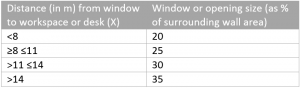
07-Oct-2025 - Applicability to INC V6 confirmed
View out – eye level - KBCN0581
BREEAM defines an adequate view out as being at seated eye level (1.2 – 1.3m) within the relevant building areas. However, where occupants will not have the option to be seated, for example in some industrial operational areas where the work being undertaken requires occupants to remain standing, the height of the view out can be changed accordingly to suit the eye level of occupants. All other view out requirements have to be met and clear justification provided for changing the height/level of the view out.
In some relevant building areas, occupants may not be sitting down to undertake tasks. Allowing the view out height requirements to be changed accordingly ensures building occupants gain maximum benefit from the view out.
View out – No relevant areas - KBCN0876
If the scope of the assessment does not include any relevant building areas, as defined within the manual, the criteria for 'view out' can be considered as met by default.
Only spaces that fall within the definition of relevant areas and are within the assessment's scope need to be assessed.
View out – percentage area - KBCN0166
For the view out credit, compliance must be demonstrated for the percentage of the floor area in each relevant building area, rather than the percentage of the total relevant building area in the building.
09-Oct-2025 - Applicability to INC V6 standard confirmed.
14-Feb-2017 Wording amended to clarify that the percentage must be achieved for each 'relevant building area'.
View out – relevant areas - KBCN0268
The aim of the View Out criteria is to allow occupants to refocus their eyes from close work.
Relevant areas are spaces where close work in a fixed position is carried out for sustained periods of time.
The view out criteria are therefore generally not applicable to occupied areas such as meeting rooms, or other spaces where such close work is not being carried out.
Where rooms contain areas of different functions, only relevant areas should be assessed. In this case a notional line can be drawn on the plans and calculations made based on these relevant areas only.
However, spaces such circulation routes or other transient spaces within a relevant area can only be excluded if the route or area is clearly defined by the building layout. If this is arbitrary or based solely on a proposed furniture layout, it cannot be excluded. Features of the building layout which may be considered as dictating a function area would include, for example, the position of doors or fixed furniture such as a reception desk or canteen servery.
11-Jun-2026 - Scheme applicability updated.
07-Oct-2022 - Additional paragraph added to clarify how function areas must be defined.
21-Sep-2022 - General principle of 'relevant area' added, and applicability of KBCN extended to BIU V6 Commercial.
View out – rooms used for security or other critical functions - KBCN1040
The View out criteria are not applicable to rooms containing security or critical systems or sensitive material, such as CCTV monitoring rooms.
Where it can be demonstrated that the presence of compliant windows would compromise a critical function of the space, the criteria can be considered not applicable.
19-Feb-2025 - Scheme applicability updated.
06-Mar-2018 - Published.
VOC credit issues – Clarification of scope - KBCN1797
The scope of these requirements does not include furnishings or moveable furniture, e.g. desks, seats or shelving.
It includes fixtures and fittings that are integral to the building, such as kitchen units and toilet cubicles. However, bespoke fixtures, such as purpose-made items of fixed furniture, can be excluded, as the specified compliance testing is not appropriate for such items.
Water Fountains - KBCN0648
Water fountains are generally not accepted to demonstrate compliance with Hea 04 on the basis that a typical water fountain (of the type which projects a jet of water upwards towards a user's mouth) does not allow a water bottle to be filled, and therefore does not encourage adequate fluid intake.
However, if it can be demonstrated that a particular type of water fountain is specified that addresses the issues of bottle filling, such as a water fountain with an additional bottle-filler, this can be considered acceptable.
Zoning and control – Dimming - KBCN1018
Localised dimming controls installed in line with the criteria, along with a master on/off switch, can be considered as meeting the aim of the requirement for 'controls' in open plan offices.
The aim is for occupants to have local control over their lighting and maintain comfortable lighting levels.
Zoning and occupant control – access to lighting controls - KBCN00032
The relevant areas for the criteria apply only to areas where users are expected to have control.
For instance, this means that areas intended for the general public, or a shop floor would not be expected to have lighting controls.
The general principle which applies to user access to general environmental controls (heating, cooling, ventilation) may also apply to access to lighting controls. See
KBCN0170.
However, the the exact approach may differ between the two types of systems and assessor judgement must be used to determine compliance.
In all cases zoning is required in all areas of the asset where specified in the assessment criteria. Please refer to the specific requirements of the applicable BREEAM standard to interpret this guidance appropriately.
14-Dec-2022 - KBCN applicability updated to include BIU. Wording updated. Link to KBCN0170 created.
Zoning and occupant control – control via BMS - KBCN0703
Occupant control via a BMS is not normally considered a compliant BREEAM solution. Any solution that requires the action of a third party (e.g. facilities manager) is not considered under the control of the occupant. Solutions where all relevant building occupants have control via a user-interface via BMS may be considered compliant where the assessor is satisfied that the aim of the criteria are met.
User-control must be available directly to the occupant.
21-Jul-2026 - Applicability updated
01-Aug-2017 - KBCN applicability to Thermal comfort Issue removed.
Zoning and occupant control – PIR detection systems - KBCN0335
The aim of the Health & Wellbeing category is to recognize ways to benefit occupants through giving them control of their lighting environment. Without manual overrides, presence or absence detection lighting controls (such as PIR detection systems) are not compliant with the criteria.
BREEAM recognises the energy efficiency benefits of detection systems in buildings through the Energy category. In some cases, the design team may have to prioritize one particular lighting strategy to the detriment of achieving a credit elsewhere.
Information correct as of 19thOctober 2026. Please see kb.breeam.com for the latest compliance information.