
New Construction / International / V6 / 02 - Health and wellbeing /
Hea 01 - Visual comfort
Information correct as of 19thOctober 2026. Please see kb.breeam.com for the latest compliance information.
BREEAM Daylighting – Alternative methods - KBCN1821
Within the BREEAM daylight criteria, there are two detailed calculation options of either using the average daylight factor method or average and minimum daylight illuminance method.
The use of the standards within the table below, can now be used as approved alternative calculation methods. The performance requirement must be met in line with either the standard or exemplary criteria as set out in the table below:
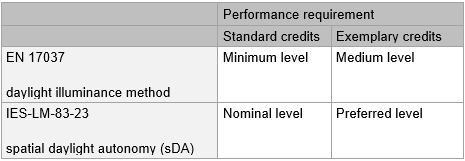
To use either the EN 17037 or IES-LM-83-23 option, the methodology within Guidance Note 50 must be followed. In addition, the minimum percentage area to comply, dependant on the building type and space type, must be met in accordance with the criteria within the relevant BREEAM issue. To calculate the percentage of assessed area that complies, follow
KBCN0471 or
KBCN1081.
Example:
A school using the International New Construction V6 scheme, has used the IES-LM-83-23 sDA method to calculate the daylight performance. The nominal level is achieved in all occupied spaces. The minimum area to comply is set at 80% as per table 10 and 12. As 100% of occupied spaces meet the nominal level, 2 credits can be met.
Erratum – Applicability of ‘Internal lighting’ and ‘zoning and occupant control’ criteria to Residential buildings - KBCN0978
These criteria, i.e. 7 to 9 and 11 to 13, are not applicable to Residential buildings.
Technical manual to be updated in the next reissue.
External lighting – architectural façade lighting - KBCN0650
Architectural facade (or other decorative) lighting which does not provide users with lighting to perform tasks outdoors does not need to be included in the assessment of external lighting.
This Issue seeks to ensure that lighting levels are appropriate for tasks which building users will be undertaking outdoors.
External lighting – High frequency ballasts - KBCN0278
The requirement for all fluorescent and compact fluorescent lamps to be fitted with high frequency ballasts does not apply to external lighting.
Glare control – use of tinted windows - KBCN0862
Solar control or 'tinted' glazing could potentially support the attainment of this requirement. However, the assessor must be satisfied and provide evidence to demonstrate that the particular glazing type, when used on the assessed building for a given location, is meeting this overarching aim of preventing disabling glare. It should be noted that whilst certain types of glazing, such as low emissivity glazing, may be slightly tinted, they may not necessarily be effective in reducing disabling glare.
For facades receiving direct sunlight, tinted windows alone are unlikely to be sufficient in the majority of situations.
Glare control for roof lights - KBCN0319
Where roof lights are present, they must be considered when demonstrating that the glare control strategy provides adequate control/measures for minimising glare in that space.
All sources of glare need to be considered when designing out the potential for disabling glare.
Glare control in residential areas - KBCN00040
Glare control criteria apply to building areas such as study bedrooms or facility management offices, where work or study will be carried out and where glare would hinder such activities. It does not apply to other residential areas.
Glare control – Modelling - KBCN1800
The ‘Glare control’ criteria do not require a specific methodology to be used to identify areas at risk of glare, and in most situations, a simple solar path analysis would be suitable. Alternatively, detailed hourly modelling methods, such as DGP and ASE, may be more appropriate. However, in either case, compliance cannot be assumed.
Regardless of the methodology used, the modelling must be supported by robust reporting to demonstrate that each aspect of the criteria has been met.
High frequency ballasts - KBCN0284
Fluorescent and compact fluorescent lamps are the only types of lighting where high frequency ballasts are required. The requirement does not apply to any other type of lamps.
Internal lighting levels where computer screens are used - KBCN0283
For areas where computer screens are regularly used projects can specify 300 lux, as referenced in CIBSE Lighting Guide 7, rather than the levels prescribed in the standard EN 12464:2011.
07 Dec 2021 Applicability to BIU V6 Commercial confirmed.
Pods or privacy booths used as workstations – Impact on view out - KBCN1697
Provided the space or room itself is compliant based on a more traditional furniture arrangement, the enclosure of workstations in booths or pods can be disregarded when considering compliance with the ‘View out’ criteria.
Studio Bedroom Daylighting Calculations - KBCN0733
Where studio rooms in multi-residential projects include multiple area types (e.g. A kitchen and lounge area), compliance can be achieved where either:
1. The entire studio room meets the more onerous requirements
or
2. The room is nominally divided into the relevant spaces and the requirements are applied to each as appropriate.
View out – Bedrooms in Residential and Residential institutions - KBCN1798
The 'View out' criteria are generally not applicable to bedrooms in assessments of Residential and Residential institutions (long-term stay and short-term stay), where the occupants are likely to be elsewhere during the daylight hours. Although a multi-purpose desk or work surface may often be provided in bedrooms for short-term working, study and other uses, this would not normally be considered as a dedicated workspace.
An exception to this would be where a separate dedicated office or study space is provided, for example within a bedroom suite. Please also refer to any building-type-specific guidance, as bedrooms in sheltered housing, for example, may be considered differently.
It is the role of the assessor to determine whether individual spaces should be determined as ‘relevant building areas’ in accordance with guidance provided.
View out – communal lounges, living rooms and bedrooms - KBCN1828
The default criteria for these space types requires relevant positions to be within 5m of an opening.
Where larger spaces are ≥ 50m2 NIA, the standard view out criteria for the relevant scheme is applied instead.
The 5m rule is intended for small scale domestic spaces where proximity to a view out is beneficial. This KBCN recognises that for larger relevant spaces in Residential, Multi-Residential and Residential Institution asset types, a scalable approach in line with commercial buildings is more appropriate.
View out – Corrections to Table - KBCN1136
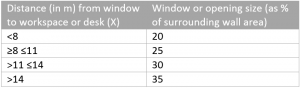
The values for distance from window to workplace in the View out Table are incorrect. The Table should read as follows:
07-Oct-2025 - Applicability to INC V6 confirmed
View out – eye level - KBCN0581
BREEAM defines an adequate view out as being at seated eye level (1.2 – 1.3m) within the relevant building areas. However, where occupants will not have the option to be seated, for example in some industrial operational areas where the work being undertaken requires occupants to remain standing, the height of the view out can be changed accordingly to suit the eye level of occupants. All other view out requirements have to be met and clear justification provided for changing the height/level of the view out.
In some relevant building areas, occupants may not be sitting down to undertake tasks. Allowing the view out height requirements to be changed accordingly ensures building occupants gain maximum benefit from the view out.
View out – No relevant areas - KBCN0876
If the scope of the assessment does not include any relevant building areas, as defined within the manual, the criteria for 'view out' can be considered as met by default.
Only spaces that fall within the definition of relevant areas and are within the assessment's scope need to be assessed.
View out – percentage area - KBCN0166
For the view out credit, compliance must be demonstrated for the percentage of the floor area in each relevant building area, rather than the percentage of the total relevant building area in the building.
09-Oct-2025 - Applicability to INC V6 standard confirmed.
14-Feb-2017 Wording amended to clarify that the percentage must be achieved for each 'relevant building area'.
View out – relevant areas - KBCN0268
The aim of the View Out criteria is to allow occupants to refocus their eyes from close work.
Relevant areas are spaces where close work in a fixed position is carried out for sustained periods of time.
The view out criteria are therefore generally not applicable to occupied areas such as meeting rooms, or other spaces where such close work is not being carried out.
Where rooms contain areas of different functions, only relevant areas should be assessed. In this case a notional line can be drawn on the plans and calculations made based on these relevant areas only.
However, spaces such circulation routes or other transient spaces within a relevant area can only be excluded if the route or area is clearly defined by the building layout. If this is arbitrary or based solely on a proposed furniture layout, it cannot be excluded. Features of the building layout which may be considered as dictating a function area would include, for example, the position of doors or fixed furniture such as a reception desk or canteen servery.
11-Jun-2026 - Scheme applicability updated.
07-Oct-2022 - Additional paragraph added to clarify how function areas must be defined.
21-Sep-2022 - General principle of 'relevant area' added, and applicability of KBCN extended to BIU V6 Commercial.
View out – rooms used for security or other critical functions - KBCN1040
The View out criteria are not applicable to rooms containing security or critical systems or sensitive material, such as CCTV monitoring rooms.
Where it can be demonstrated that the presence of compliant windows would compromise a critical function of the space, the criteria can be considered not applicable.
19-Feb-2025 - Scheme applicability updated.
06-Mar-2018 - Published.
Zoning and control – Dimming - KBCN1018
Localised dimming controls installed in line with the criteria, along with a master on/off switch, can be considered as meeting the aim of the requirement for 'controls' in open plan offices.
The aim is for occupants to have local control over their lighting and maintain comfortable lighting levels.
Zoning and occupant control – access to lighting controls - KBCN00032
The relevant areas for the criteria apply only to areas where users are expected to have control.
For instance, this means that areas intended for the general public, or a shop floor would not be expected to have lighting controls.
The general principle which applies to user access to general environmental controls (heating, cooling, ventilation) may also apply to access to lighting controls. See
KBCN0170.
However, the the exact approach may differ between the two types of systems and assessor judgement must be used to determine compliance.
In all cases zoning is required in all areas of the asset where specified in the assessment criteria. Please refer to the specific requirements of the applicable BREEAM standard to interpret this guidance appropriately.
14-Dec-2022 - KBCN applicability updated to include BIU. Wording updated. Link to KBCN0170 created.
Zoning and occupant control – control via BMS - KBCN0703
Occupant control via a BMS is not normally considered a compliant BREEAM solution. Any solution that requires the action of a third party (e.g. facilities manager) is not considered under the control of the occupant. Solutions where all relevant building occupants have control via a user-interface via BMS may be considered compliant where the assessor is satisfied that the aim of the criteria are met.
User-control must be available directly to the occupant.
21-Jul-2026 - Applicability updated
01-Aug-2017 - KBCN applicability to Thermal comfort Issue removed.
Zoning and occupant control – PIR detection systems - KBCN0335
The aim of the Health & Wellbeing category is to recognize ways to benefit occupants through giving them control of their lighting environment. Without manual overrides, presence or absence detection lighting controls (such as PIR detection systems) are not compliant with the criteria.
BREEAM recognises the energy efficiency benefits of detection systems in buildings through the Energy category. In some cases, the design team may have to prioritize one particular lighting strategy to the detriment of achieving a credit elsewhere.
Information correct as of 19thOctober 2026. Please see kb.breeam.com for the latest compliance information.