
New Construction / UK /
V7
Information correct as of 29thSeptember 2026. Please see kb.breeam.com for the latest compliance information.
ANC membership/registration scheme compliance route - KBCN0246
The Association of Noise Consultants (ANC) registration scheme is only applicable to buildings covered in Approved Document E. It therefore covers Dwellings-Houses, flats and rooms for residential purposes and schools, and so would only apply to assessments that contain these room types. For these assessments, if the suitably qualified accoustician is a member of the ANC, they must also provide evidence to demonstrate that they are a full member of the ANC registration scheme.
For all other building/room types, assessors can still demonstrate compliance by the other routes listed in the manual.
Areas in the public domain - KBCN0587
Where areas within the site boundary will be public domain after construction, and the design/specification has been determined by the local authority/statutory body/planning permission etc, they can be excluded from the assessment of the 'Safe Access' criteria. Evidence would be required to demonstrate that this was the case.
Where the client/design team do not have control of the design of these areas, the development should not be prevented from achieving the credit.
Bamboo, cork and other non-timber forest products – Responsible sourcing - KBCN1768
Non-timber forest products, such as bamboo and cork should be responsibly sourced to minimise the environmental impacts and protect local ecosystems. However, as they are not timber or timber-based products, these fall outside the scope of the Prerequisite.
Where such products are integrated into a building, they should, nonetheless, be assessed and included in the calculator under ‘Other materials’.
BREEAM Excel Tools - KBCN1755
The new BREEAM Platform now integrates all Excel-based calculator tools directly into the system for a more streamlined experience. Simply input your data, and the platform will automatically calculate and display the results.
Please note, this functionality currently applies only to BREEAM New Construction V7.
BREEAM New Construction V7 – FAQs - KBCN1754
The FAQ webpage has been developed to provide early clarification and guidance on aspects of BREEAM New Construction Version 7 (NC V7). It is intended to address questions and highlight key changes from previous versions.
Further guidance is provided within the published technical manual, and this will be supplemented by Knowledge Base Compliance Notes (KBCNs).
To see the full list of FAQs, please refer to the
Version 7 FAQs webpage
Campus or campus-type developments – Entrance to consider - KBCN1726
For assessments on sites with multiple buildings (e.g. education campus, business or industrial parks):
- Distances to amenities and public transport nodes can be measured from the site’s main entrance if ≥80% of buildings are within 1000 m. Otherwise, use the assessed building’s main entrance, and in such cases, where multiple buildings are included, calculations must always be based on the worst-case scenario (the entrance furthest from the node or amenity)
- Where the site has more than one main entrance, either entrance may be used for the calculation.
Purpose: To ensure fair assessment on large sites and to encourage the provision or location of amenities and public transport nodes within or at the periphery of the site.
Note: wording update for clarification and including BIU
Capped gas supplies – Shell & core assessments - KBCN1818
If a capped-off gas supply is provided, this does not prevent credits from being awarded under criterion 1. The key requirement is that all heating and hot water systems designed or installed within the scope of works (the core services) must use non-combustion systems.
Car sharing – aim and principles - KBCN1510
Aim
The aim of this measure is that the asset’s management establishes, promotes and administers a process which encourages building users to share private car journeys to and from work, reducing the number of cars used for this purpose.
Principles
A car sharing group will, generally:
- Be available to all building users who normally travel to work by private car.
A car sharing group is not:
- A vehicle hire/loan scheme.
- Intended to offset journeys which would otherwise have been made by public transport or active travel modes (e.g. walking or cycling).
The criteria do not prescribe what terms and conditions should be implemented and, whilst the above principles should generally be followed, specific arrangements may vary.
Evidence and justification must always be provided to demonstrate that the above aim is met.
21-Jul-2026 - Scheme applicability updated. Title updated for clarity and consistency.
Car sharing – calculation of priority spaces - KBCN0282
The calculation of priority spaces for car sharers should account only for the car parking capacity that is dedicated to the staff working in the building, without considering spaces for customers or visitors.
Car sharing spaces should be clearly segregated from customer / visitor parking areas.
21-Jul-2026 - Scheme applicability updated.
06-Sep-2023 - Title updated to align with naming protocol.
23-Mar-2017 - Note added clarifying requirement for segregation.
Car sharing – location of priority parking - KBCN0796
Priority spaces for car sharers need to be located in the nearest available parking area to the main building entrance or to an entrance regularly used by the car sharers.
For refurbishment projects, this applies regardless of whether external works or changes to car parking areas are within the scope of works.
Assigning and clearly marking out the location of priority parking spaces is a measure that can be taken by any project regardless of scope, provided there are suitable external parking areas.
21-Jul-2026 - Scheme applicability updated. Wording expanded to clarify how KBCN applies to refurbishment projects. Title updated for consistency.
22-Sep-2022 - Applied to UK NC 2018.
Car sharing – speculative projects - KBCN0878
This measure will generally be unavailable to speculative projects.
To fully implement the car sharing option, the building occupants need to be known and signed up to a car sharing scheme in line with the criteria.
21-Jul-2026 - Scheme applicability updated. Title updated for clarity.
Clarification of ‘Embodied carbon benchmark comparison’ - KBCN1819
The
embodied carbon benchmark comparison must always be based on the
latest appropriate LCA stage that corresponds to the BREEAM assessment stage being pursued.
The purpose of the benchmark comparison is to assess
outcome-based embodied carbon performance, using data that is representative of the building at the relevant assessment stage.
Assessment stage requirements
Interim (Design Stage) BREEAM assessments
- Where an interim / design stage assessment is being submitted:
- The benchmark comparison may be based on a Technical Design LCA, where this represents the latest LCA available at that stage.
- Benchmark results at this stage are indicative and intended to support design decision-making.
Final Post-Construction Stage (PCS) BREEAM assessments
- Where a final post-construction stage (PCS) assessment is being submitted:
- Benchmark comparison credits can only be awarded where a Post-Construction Stage (PCS) LCA has been completed.
- A technical design LCA alone is not sufficient to support benchmark comparison credits at PCS.
- This is because the PCS LCA is the only assessment that reflects the materials and products actually installed in the completed building, and therefore the only suitable basis for outcome-based benchmarking.
If a PCS LCA is
not undertaken, benchmark comparison credits
cannot be awarded at final assessment, regardless of whether a technical design LCA was previously completed.
This aligns with wider industry frameworks (e.g. RICS WLCA v2 and the UK Net Zero Carbon Buildings Standard), which anchor performance claims to as-built outcomes.
Clarification of ‘rural location’ in England and Wales - KBCN1824
A rural location is defined as any settlement with a resident population of fewer than 10,000 people, including rural towns, villages, hamlets and dispersed dwellings, as set out in the Government’s Rural‑Urban Classification (RUC).
Compensating for habitat loss – Habitat type - KBCN1772
When compensating for habitat loss, any habitat type lost should be compensated for by the same habitat type.
This is to ensure that it is capable of supporting the species affected by the habitat loss resulting from the development.
Considerate Constructors Scheme – Phased developments - KBCN0328
The Considerate Constructors Scheme does make provision for phased developments within the registration process, allowing each phase to be registered separately. They make this provision to allow for very large developments that may go on over several years. It should therefore be possible for the developer to register the site in phases, so that CCS certificates can be submitted for BREEAM assessed buildings, without having to wait for the completion of the final phase.
Contractual agreements for Shell Only / Shell & Core assessments - KBCN0942
For:
- NC: Shell Only and Shell and Core assessments, or
- RFO: Part 1, Part 2, and combined Part 1 & 2 assessments,
All relevant criteria are applicable. Contractual agreements confirming future provision of spaces are not acceptable. Either:
- Evidence must be provided showing waste storage space(s) that are suitably sized, dedicated and unlikely to be used by the future tenants for other purposes. or
- If the situation meets one of the accepted scenarios in KBCN0696, provide evidence for the alternative approach as outlined in that KBCN.
While the location of the space(s) may change when fitting out, at this stage a space that is conveniently located for the deposit and collection of operational waste must be provided.
30-Mar-2026 - Added text to align with KBCN0696. Scheme applicability updated.
16-Apr-2018 - Scheme applicability updated.
24-Apr-2017 - Published.
Credit requirement for an “Excellent” or “Outstanding” – Connection to district heating is a condition of Planning - KBCN1766
This KBCN applies when a project is required to connect to a district heating system as a condition of planning and this is preventing the project from achieving the number of credits required for a BREEAM Excellent or Outstanding rating.
In these situations, an additional brukl.inp file must be generated for the actual building but with an alternative heating system, e.g., a heat pump, that demonstrates that the minimum standard would be achieved if the building didn’t have to connect to district heating.
A technical query must be raised citing this KBCN and stating the minimum standard being sought with two brukl.inp file attached, one for the actual building with district heating and one with the alternative with an alternative heating system.
Where the brukl.inp documents demonstrate that requirement to district heating is the only thing preventing the project from achieving the required number of credits, the technical team will confirm and arrange for the minimum standard to be waived.
However, the number of credits awarded must be based on the building connected to district heating.
Definition of concourse - KBCN0386
A concourse is an open area within or in front of a public building which is used primarily for circulation, short term waiting, or incidental interaction, analogous to the concourse of a train station. It should not be considered occupied space.
Early design phase LCA submission – Modified planning applications - KBCN1893
Requirement
In the Mat 01 Methodology, M1.2 requires the early design phase LCA to be completed and submitted to BREEAM within 20 working days of submission of the planning application.
Intent
This requirement is in place to ensure that the LCA is carried out during the early design stages and can meaningfully influence material selection and key design decisions, before the planning application fixes significant aspects of the external specification.
The timeframe of 20 working days post-planning submission is a concession to allow project teams to collate the LCA evidence for submission to BREEAM.
Submission of the planning application
In this context, this is the application that specifies and fixes the external products and materials that are considered in the LCA. By default, this is considered as the first application.
However, it may also be:
- A supplementary modified application, where a staged submission process is used
- A replacement modified application, due to a major redesign
Where the requirement is applied to a supplementary or replacement application, the project team must provide additional evidence to demonstrate that the intent is met.
Additional evidence
- Confirmation of the date of the original planning application and the date of the modified application.
- A description of what the modified application changes, with reference to the relevant submission documents.
- Evidence that the modification significantly affects external products or materials specification, e.g. revised elevations, façade specification, external material schedules
- Justification of how the early design LCA submitted in relation to the modified application was still capable of influencing relevant design decisions
Ecological Clerk of Works - KBCN1771
If the project is using the comprehensive route to assess the ecological value of the site but the site has a low ecological value (for example, if it is mainly hardstanding), hiring an Ecological Clerk of Works may be an unnecessary cost for the developer. If the appointed SQE confirms that it is unnecessary to hire an Ecological Clerk of Works, then the requirements for the foundation route (nominating a biodiversity champion) can be applied, whilst still following the comprehensive route.
Electric Vehicle (EV) Charging – Shared Parking for New Buildings, Extensions, and Phased Developments - KBCN1827
The required number of EV charging points must be based on the total number of parking spaces that
serve the assessed building. This total includes both
existing spaces and
any new spaces associated with the project.
Where parking is shared across a wider site, the “associated” number of spaces refers to the amount of parking the assessed building is expected to rely on for its occupants. A
proportional allocation calculation must be used to determine this number.
Example:
If a project sits on a site with 1,000 shared spaces but the new building’s occupancy requires only 100 spaces, the EV requirement is calculated based on
100 spaces, not the full 1,000.
- General Requirements
- Defining the parking that counts. Use a proportional allocation method to determine how many spaces in a shared car park are associated with the project.
- Short-stay exclusion: Short-stay spaces with a maximum stay of 15 minutes (e.g., pick-up/drop-off bays) are excluded from the EV calculation.
- EV Charging points location: EV charging points should be installed as close as possible to the building’s main entrance to ensure convenient access for the building users.
- Existing infrastructure: Existing EV charging points in a shared car park can only be counted when:
- They exceed the BREEAM requirement for the buildings they were originally installed to serve,
- They meet current BREEAM requirements, and
- They form part of the new project’s allocated parking.
- No “legacy” exclusions: Existing parking spaces cannot be excluded simply because they predate the BREEAM assessment. If the spaces serve the assessed building, they are in scope.
- Operational policy. It is recommended, but not mandatory, that building management implement operational measures (e.g., signage, permits, digital access controls) to help ensure that EV spaces are used by the intended building users.
- New Buildings on a Site or Extensions
- Calculation basis for new buildings or extensions, EV requirements must be based on the total parking demand associated with the project, including both existing associated spaces and any new spaces created.
- Proportional allocation formula
- Determine the project’s share of the total site parking using either GIA or occupancy.
- Allocated project parking = Total site parking × (Project GIA ÷ Total GIA), OR
- Allocated project parking = Total site parking × (Project occupancy ÷ Total occupancy)
- Phased Development
- Current Phase: The EV calculation should be based on the parking demand of the phase under assessment, including the existing infrastructure and any new parking spaces delivered in that phase.
- Existing Infrastructure: EV charging provision installed in previous phases may count towards compliance where it meets the required threshold for the current phase
- Future Phases: Provisions in future phases may be counted only if secured by a legally binding commitment (such as a signed contract or planning obligation) with a confirmed delivery timeline.
Elemental LCC and options appraisal timing - KBCN1889
The elemental LCC should be undertaken as part of the strategic options appraisal process and used to inform the selection of significant building elements and systems, such as the structure, envelope and building services. Completing the options appraisal after key design decisions have been finalised may reduce its effectiveness and limit the opportunity for the findings to influence the final design.
However, the timing requirement can still be met, where the assessor agrees that there is a justification for the appraisal continuing into early RIBA Stage 3 (or equivalent), and clear evidence to demonstrate that:
- The key options remained under consideration during the appraisal.
- The findings were capable of influencing the final design solution.
- The intended outcomes of the elemental LCC process have not been compromised.
In all cases, the outline elemental LCC plan and identification of relevant project options must be completed by the end of Concept Design
Emissions from construction products – Re-used and reclaimed products - KBCN1869
The Emissions from construction products criteria in BREEAM are intended to apply to newly manufactured construction products and materials.
Where a construction product can be robustly identified as previously used and is re-used or reclaimed, it may be considered as outside the scope of the Emissions from construction products criteria.
However, any new coatings, finishes, adhesives, sealants, or other chemical treatments applied for the product’s installation must be considered and assessed separately, where relevant.
Emissions from products – earlier versions of AgBB standard - KBCN0655
Guidance Note GN22 lists the standard AgBB (2015) as a recognised scheme for emissions from building products for pre-December 2015 launched BREEAM schemes.
Previous versions of the AgBB scheme are not listed as recognised schemes because earlier versions of AgBB did not include any requirement for the testing of Formaldehyde.
If an earlier version AgBB has been used, further evidence will be required to provide additional information on the required Formaldehyde testing.
10-Oct-2022 - Title amended to align with standard KBCN naming format for clarity and consistency. Made applicable to UK and International NC V6.
Emissions from products – Paints and varnishes – Historic buildings - KBCN1041
Scope
This KBCN covers the use of paints and varnishes for the 'emissions from products' criteria. These are paints that:
- May contain high VOC content exceeding BREEAM limits or
- Falls within the scope of 'Volatile Organic Compounds in Paints, Vanishes and Vehicle Refinishing Products Regulations 2012'.
These paints may be used in new extensions to historic buildings (this KBCN is a manual compliance note in RFO 2014).
Exemptions for use
The use of such paints is allowable if:
- There is an explicit requirement from the local authority conservation officer or the national conservation body to use specific paints and varnishes and
- The building is listed and protected under a historic buildings register.
Localisation
National conservation bodies and accepted grade listings applicable to this KBCN are:
- England: English Heritage - Grade I and II*.
- Wales: Cadw - Grade I and II*.
- Scotland: Historic Scotland - Grade A and B+.
- Northern Ireland: Department for Communities (HIstoric Environment) - Grade A and B+.
Remedial actions
In all cases, procedures are in place to flush the building out for a sufficient period before occupation. This is to reduce the risks associated with VOCs in accordance with the criteria.
11-Oct-2022 KBCN restructured for clarity. Title amended for clarity. National conservation body for NI updated. Scheme applicability updated.
Emissions from products – scope of assessment - KBCN0212
General
This issue covers any product installed or applied inside the inner surface of the building’s infiltration, vapour or waterproof membrane.
Where this membrane is not present, it applies to the inside of the building envelope’s interior-facing thermal insulation layer.
Only products that are installed or applied in parts of the building where their emissions are likely to affect indoor air quality need to be assessed.
Paints and coatings
Any decorative paints and varnishes that occupants are exposed to should be assessed.
This is likely to include paints and coatings applied to walls, ceilings, floors, doors, etc.
Whole products
A finish applied to a product in the factory is assessed as a whole product, and not separately as a paint or coating.
For instance, a wood panel has a finish applied in the factory. The whole panel, including all the elements that make up that panel, would need to comply with the requirements set for wood panel products in this issue.
The finished product as a whole must meet the performance requirements / emission limits set in the manual.
30-Oct-2025 - Applicable to HQM V6 and UKNCR V6.1
11-Oct-2022 - Title amended for clarity and consistency. Content merged with KBCN0871.
10-Oct-2022 - Wording simplified. Scheme applicability updated.
16-Jun-2017 - Title and general principle amended to extend the applicability of the KBCN to all finishes. Paints specified for specialist applications covered in KBCN0872.
Emissions from products – specialist paints and coatings - KBCN0872
Where a paint or coating falls within:
- A category in Annex II of the EU Directive 2004/42/CE or,
- A category in the relevant product emission table of the technical manual,
then the paint or coating must be assessed.
Specialist paints and coatings are exempted from meeting the VOC content and emission limits where there are no alternative products available that can perform the function, and still meet the emission limits.
This must be clearly evidenced.
30-Oct-2025 Applicable to HQM V6 and UKNCR V6.1
02-Oct-2025 Reference to 'VOC content' added and KBCN applied to UKNC V7 and INC V7 to clarify CN2.1
27-Oct-2022 Wording clarified. New compliance principle added from UKNC V6.
10-Oct-2022 Title amended for clarity. Scheme applicability updated.
13-Mar-2020 KBCN amended to clarify exceptions and applicability.
16-Jun-2017 Content merged with KBCN0212.
ERRATUM – Enhanced Amenities - KBCN1817
The wording and approach to assessing ‘enhanced’ amenities in the technical manual is incorrect. The Aim of this assessment issue is, ‘To maximise the potential for people to choose public, active and lower-emission private transport by providing the site with convenient, sustainable options.’
In line with this intent, an ‘enhanced amenity’ should be referred to as an additional amenity, as it must provide an additional compliant amenity resulting from the development. If a development provides an amenity to replace an existing amenity, regardless of whether there is a qualitative enhancement or change of amenity type, this must be considered as an existing amenity.
Furthermore, an additional amenity provided by the development may only be considered as such where there is a net increase in the number of compliant amenities resulting from the development.
The updated guidance can be found below:
Option 10 - Additional amenities:
Provide compliant additional amenities within less than or equal to 500 m of the building entrance.
M4.2: Additional amenities
Two or three points can be awarded for providing additional amenities ≤ 500 m via a safe pedestrian route.
If additional amenities duplicate the services provided by existing amenities, this is still recognised. This is because duplicate amenities still create additional choices for users in terms of services offered and location.
If a development provides an amenity to replace an existing amenity, regardless of whether there is a qualitative enhancement or change of amenity type, this must be considered as an existing amenity.
A new amenity provided by the development may only be considered as ‘additional’ where there is a net increase in the number of compliant amenities resulting from the development.
2 points: at least one additional amenity
3 points: two or more additional amenities
This will be updated in the next reissue of the technical manual.
ERRATUM – Minimum standards Table 2.3 – Man04 - KBCN1832
The minimum standard for a very good rating within BREEAM issue Man04 Commissioning and handover, should refer to Criterion 11 and not criterion 12. The updated text can be found below:
- Technical and non-technical building user guide written. Criterion 11 (Handover)
01-Apr-2026 Technical manual will be updated accordingly in the next reissue
Erratum – NCV7 – Ene 08 Installed controls - KBCN1812
There is a printing error in the following:
UKNC V7 Ene 08 Table 6.18
INC V7 Ene 08 Table 43
The correct options for Installed controls for space heating are:
| Control type |
Control functionality |
Points awarded |
| Heat generator output – heat pumps |
Multi-stage control (e.g. several on/off compressors) |
1 |
| Variable control (e.g. hot gas bypass, inverter frequency control) |
2 |
The technical manual will be updated accordingly in the next re-issue.
Erratum – Monitoring utility consumption – Meeting the set targets - KBCN1899
The target and actual total energy and water consumption figures must be entered into the platform. However, meeting the targets is not required for compliance. The relevant criteria will be clarified in the next reissue.
KBCN Reinstated 24-Sep-2026
Erratum – NC V7 – Ene 07 Flexible demand response - KBCN1876
This applies only to the UKNC V7.0 and INC V7.0 manuals.
There is an error in the following:
UKNC V7.0.0 Ene 07 Table 6.16
INC V7.0.0 Ene 07 Table 41
- Other systems or equipment is now shown separately from Battery energy storage systems
- The options and number of points scored under Battery energy storage systems have been reformatted for clarity
The corrected table is below:
| Systems present |
Points available |
Flexible demand capability |
Points awarded |
| Electric space heating |
1 |
Operation can be optimised based on signals from the electricity supplier or local renewable sources. |
1 |
| Electric space cooling |
1 |
Operation can be optimised based on signals from the electricity supplier or local renewable sources. |
1 |
| Electric domestic hot water |
1 |
Operation can be optimised based on signals from the electricity supplier or local renewable sources. |
1 |
| Electric vehicle charging points |
2 |
Charging with one-way control based on signals from the electricity supplier or local renewable sources. |
1 |
| Charging with two-way control based on signals from the electricity supplier or local renewable sources. |
2 |
| Other systems or equipment with flexible demand capability |
1 |
Installed |
1 |
| Battery energy storage |
3 |
Installed battery energy storage with no flexible demand response capability. |
1 |
| The installed battery energy storage system is only capable of charging based on signals from the electricity supplier or local renewable sources. |
2 |
| The installed battery energy storage system is only capable of feeding electricity back into the grid. |
2 |
| The installed battery energy storage system is capable of both charging and feeding electricity back into the grid, based on signals from the electricity supplier or local renewable source. |
3 |
The technical manual will be updated accordingly in the next re-issue. The scoring for the Ene 07 calculator in the platform aligns with the above corrected table.
Erratum – Part new-build, part refurbishment projects - KBCN1903
This supersedes the guidance in:
- BREEAM Refurbishment Commercial V7.0
- BREEAM International New Construction V 7.0
- BREEAM UK New Construction V 7.0
Where the new-build area is < 50% of the project gross internal area:
- BREEAM Refurbishment can be used.
- The scope of the assessment for the new-build element must align with the Parts selected for assessment, which must include Part 1.
Where the new-build area is ≥ 50% of the project gross internal area:
- A single BREEAM Refurbishment assessment is not appropriate.
- RFO-NC Bespoke assessments are no longer available.
The options are:
- Separate BREEAM Refurbishment and BREEAM New Construction assessments Two separate certificates will be issued to indicate the performance of the new-build and refurbishment areas respectively.
- BREEAM New Construction A single New Construction assessment can be used for the whole development, regardless of the percentage of new-build area. Both the new-build and refurbished areas must be assessed against the more challenging New Construction criteria.
Definition
Project gross internal area – The combined gross internal area of the refurbishment and the new build
KBCN Reinstated 24-Sep-2026
ERRATUM – Scope – Mixed-use developments and building types - KBCN1820
The wording and approach set out for assessing mixed-use developments in the technical manual is incorrect. Developments comprising of separate buildings with different function types cannot be assessed under a single assessment, unless they meet the conditions for Section 6 of GN20 (Separate buildings with a single, over-arching function). The updated guidance can be found below:
Mixed-use developments and building types
BREEAM defines different criteria and benchmarks for some assessment issues according to building type, function and use. A single building that includes different functions areas, e.g. office and retail, can be assessed under a single BREEAM assessment. Each area will need to comply with the relevant criteria for the building type. BREEAM credits that are awarded based on performance scales, such as Ene 01, Ene 02, Wat 01 and Mat 01, will be calculated on an area weighted basis.
Buildings that are a mix of commercial and residential asset types, and developments which comprise of separate buildings with different function types, will need separate BREEAM assessments.
Further guidance can be found in Guidance Note 20.
Erratum – UK NC V7 – Mat 01- Table 9.2: LCA Study Periods - KBCN1830
In Table 9.2: LCA quality requirements: Item 9, the study period should be 60 years for all stages, in line with RICS.
This is a typographical error in the Technical Manual and will be corrected in the next re-issue.
Erratum – Wat 01 – Data requirements for Urinals - KBCN1878
Table 8.2 / Table 62: Data requirements for water-consuming components
incorrectly states that the data should be entered as “Flush volume in litres/bowl/hour” for all types of urinals
| Water-consuming component |
Data requirements |
| Urinals |
Flush volume in litres/bowl/hour |
These units should only apply to urinals with a timed flush. Data for urinals with automatic flush should be entered in Flush volume in litres/flush (see below)
| Water-consuming component |
Data requirements |
| Urinals with timed flush |
Flush volume in litres/bowl/hour |
| Urinals with automatic flush |
Flush volume in litres/flush |
The data entry options and units are correct in the BREEAM Platform, and the technical manuals will be updated in the next reissue.
Evidence requirements – responsible sourcing of materials at post-construction - KBCN1599
Whilst the UK BREEAM manuals are less prescriptive in the evidential requirements to allow flexibility, to ensure consistency across the schemes, it is expected that robust evidence should be provided to verify the source of any certified materials and how the assessor has confirmed the products and manufacturers used.
Evidence supplied at post construction stage must reflect the completed building and confirm the responsibly sourced materials that have been procured and installed on the project. Supporting documentation is required to validate letters of confirmation or schedules of materials.
Evidence provided could include proof of purchase, for example, invoices, delivery tickets, purchase orders or correspondence from suppliers. This may be an example for each material sourced, rather than every delivery ticket for instance. Alternatively, evidence of the use of the responsibly sourced materials may include as-built drawings, O&M documentation or site photographs.
30-Oct-2025 - Applicable to HQM V6 and UKNCR V6.1
Flexibility of acoustic requirements for naturally ventilated buildings - KBCN0219
When the Design Capability Supply Rate of 8 l/s per person is provided by natural ventilation, the design can achieve the BB93 performance standards for the indoor ambient noise levels in Table 1.1 of BB93 then the requirements can be increased by 5 dB LAeq,30min. This approach can be followed where BB93 is applicable.
Flood Risk Assessment older than five years - KBCN1744
This sentence appears in the definition of 'Flood Risk Assessment': Where more than five years have passed since the FRA was carried out, evidence would be required to demonstrate that the basis of the FRA has not changed in that time.
The requirement for evidence that the basis of the FRA has not changed where more than five years have passed is applicable only at Design Stage. It is not required at Post Construction Stage where a compliant FRA was undertaken at Design Stage and the development was carried out in accordance with that design.
Food waste storage – Size of internal containers - KBCN1900
If the internal food/composting waste containers are provided by the Local Authority and the assessor considers these to be appropriate, the minimum size requirement of 10 litres can be disregarded.
Note: In UK New Construction, the above is only applicable to multi-residential buildings with individual bedrooms and communal facilities.
KBCN Reinstated 24-Sep-2026 - Previously also published as KBCN1901
Glare control – Venetian blinds - KBCN1867
Venetian blinds must demonstrably meet the openness factor and transmittance value for blinds, where specified within a BREEAM manual. If the specification data for Venetian blinds is not available, evidence of the two points below can be provided instead:
1. The blind slats can be fully closed and overlap so there are no gaps between them.
2. The slat material clearly transmits no light, for example solid and opaque plastic, wood or metal.
If the slat material is not solid and opaque, and is for example, perforated or made from woven fabric, the openness and transmittance values must be demonstrated in line with the criteria.
Glare control – Modelling - KBCN1800
The ‘Glare control’ criteria do not require a specific methodology to be used to identify areas at risk of glare, and in most situations, a simple solar path analysis would be suitable. Alternatively, detailed hourly modelling methods, such as DGP and ASE, may be more appropriate. However, in either case, compliance cannot be assumed.
Regardless of the methodology used, the modelling must be supported by robust reporting to demonstrate that each aspect of the criteria has been met.
GN06 Indoor air quality plans - KBCN0618
Latest version: v2.3, July 2026
Guidance Note 6 (GN06) provides guidance to assessors and project teams regarding the content and rigour of an Indoor Air Quality Plan (IAQP) as required by the indoor air quality criteria in BREEAM New Construction and BREEAM Refurbishment and Fit Out.
It should not be interpreted as BREEAM criteria. It is intended to provide assessors and project teams with further, flexible information and guidance regarding the rigour, content, and tasks of an IAQP.
Download Guidance Note 6
View all Guidance Notes on BREEAM Projects (licensed assessors only)
15-Jul-2026 - Updated version released (v2.3)
GN18 BREEAM Recognised Responsible Sourcing Certification Schemes and BREEAM Scheme Applicability - KBCN0723
Latest version: v3.7, May 2023
BREEAM awards credits for responsibly sourcing construction products (typically under the Mat 03 issue) to encourage responsible product specification and procurement in construction. To achieve these credits, applicable specified products (as listed in the relevant technical manual) must be covered by an Environmental Management System (EMS) or a responsible sourcing certification scheme (RSCS) recognised by BREEAM.
Guidance Note 18 (GN18) lists the responsible sourcing certifications schemes recognised by BREEAM along with the relevant summary scores to be used in BREEAM assessments.
Download Guidance Note 18
Download Guidance Note 18 v2.0 (licensed assessors only - optional for projects registered prior to release of v3.0 in September 2016)
View all Guidance Notes on BREEAM Projects (licensed assessors only)
21-Jul-2026 - Applicable to NC V6, NC V7, RFO V7
GN20 Assessing mixed-use and multiple buildings – BREEAM V7 - KBCN0717
Latest version: v1.1, July 2026
Guidance Note 20 (GN20) provides information to help BREEAM Assessors formulate an assessment strategy for mixed-use developments, assets that include different levels of fit out, and for multiple buildings or units on the same site using BREEAM V7.
This guidance note only applies to BREEAM V7. There is a separate guidance note for earlier versions of BREEAM NC and RFO (see
Guidance Note 10).
Download Guidance Note 20
View all Guidance Notes on BREEAM Projects (licensed assessors only)
15-Jul-2026 - Updated version released (v1.1)
GN22 Recognised schemes for emissions from construction products - KBCN0719
Latest version: v3.2, July 2026
Within the Health and Wellbeing category of several BREEAM schemes, credits are awarded for specifying materials that minimise emissions from building products of formaldehyde and volatile organic compounds (VOCs). The criteria involve meeting emission level performance requirements in accordance with compliant performance and testing standards.
Guidance Note 22 (GN22) lists schemes that show equivalent or better performance than the current BREEAM and HQM criteria and therefore can be used to demonstrate compliance with the criteria. This document should be read in conjunction with the relevant assessment issue guidance provided in the appropriate BREEAM or HQM technical manual.
The guidance note contains two tables:
- Table 1 is for use with BREEAM schemes that were first released before December 2015.
- Table 2 is for use with BREEAM (and HQM) schemes that were first released from December 2015 onwards (post-November 2015).
Download Guidance Note 22
View all Guidance Notes on BREEAM Projects (licensed assessors only)
Applying for inclusion in GN22
The list of approved schemes is based on those which have made a successful application to BREEAM. As such, there may be other operational schemes that could potentially be recognised.
To be considered for inclusion, the scheme operator must complete an application form, providing full details of the scheme, and submit this to BRE Global for technical approval. A flat rate charge is payable to cover the costs of administering and reviewing the application. GN22 will be updated following the approval of any schemes via this process.
The application form (BF1648) provides full details of the application process, and licensed BREEAM assessors can request a copy by submitting a technical query using the
webform. Other parties may request a copy by contacting:
breeam@bregroup.com
15-Jul-2026 - Release of GN22 3.2
25-Mar-2026 - Release of GN22 3.1
30-Oct-2025 - Applicable to HQM V6 and UKNCR V6.1
25-Sep-2025 - Updated to provide details of the approval process and title updated.
30-Jan-2025 - Release of GN22 3.0
30-Sep-2024 - Release of GN22 2.9
01-Feb-2024 - Release of GN22 2.8
31-Jan-2023 - Release of GN22 2.7
10-Oct-2022 - This KBCN merged with KBCN0646. Title amended to align with standard KBCN naming format for clarity and consistency. Made applicable to UK and International NC V6.
25-Jan-2019 - Link to Guidance Note updated
12-Mar-2018 - Link to Guidance Note updated
GN24 Demonstrating compliance with responsible sourcing requirements in BREEAM - KBCN0721
Latest version: v1.2, July 2026
Guidance Note 24 (GN24) provides additional guidance to assessors and specifiers on demonstrating compliance with the 'Measuring responsible sourcing' criteria in BREEAM (typically in Mat 03). It should be read in conjunction with the Technical Manual for the relevant assessment scheme. It covers:
- How to deal with constituent products/materials including those with certification that is different from the overall product.
- The precision required in estimating quantities:
- For the cut-off volume
- Of products/materials in the building (Route 2 only)
- Of different material categories in products/materials.
- An example Route 2 calculation.
- ‘Broken chain’ situations.
- How to treat building services.
Download Guidance Note 24
View all Guidance Notes on BREEAM Projects (licensed assessors only)
15-Jul-2026 - Updated version released (v1.2)
GN38 Relating drainage reports to BREEAM UK NC - KBCN1564
Latest version: v2.0, November 2025
Guidance Note 38 (GN38) has been produced to help assist BREEAM Assessors relate the contents of drainage reports to the ‘Surface water run-off’ and ‘Minimising watercourse pollution’ criteria in Pol 03 for BREEAM UK New Construction 2018, V6/V6.1, and V7. The guidance note does not cover the criteria for ‘Flood resilience’.
Completing the template is optional. It is an aid for demonstrating compliance and not a requirement.
A separate template exists for BREEAM UK New Construction 2014 (see
GN15).
Download Guidance Note 38
View all Guidance Notes on BREEAM Projects (licensed assessors only)
27-Nov-2025 - Release of GN38 2.0
GN41 Reporting template for ecology assessment issues – BREEAM V7 - KBCN1748
Latest version: v0.0, July 2025
Guidance Note 41 (GN41) is an optional template to help Assessors relate information generated during a project to the latest ecology assessment issues in BREEAM NC V7.
This is a new template for V7. There is a separate reporting template for previous versions of BREEAM UK NC, BREEAM UKNCR, and HQM (see
Guidance Note 40).
Download Guidance Note 41
View all Guidance Notes on BREEAM Projects (licensed assessors only)
GN50 Natural light calculation methodology for Hea 01 in BREEAM V7 - KBCN1683
Latest version: v1.0, July 2026
Guidance Note 50 (GN50) describes the calculation methodologies that underpin the natural light issue (Hea 01) within BREEAM V7. Guidance is provided for methodologies relating to the daylight criteria and the evaluation of glare from daylight criteria. All the calculation methods outlined in the technical manual for these criteria are described in this guidance note.
Download Guidance Note 50
View all Guidance Notes on BREEAM Projects (licensed assessors only)
15-Jul-2026 - Updated version released (v1.0)
GN51 Guidance on LCA and embodied carbon calculations for Mat 01 in BREEAM V7 - KBCN1684
Latest version: v1.0, July 2026
Guidance Note 51 (GN51) provides supporting information for the new Mat 01 criteria in BREEAM V7. Its development is driven by the introduction of new credit allocation criteria for Mat 01. While the core principles of measuring and reporting a building's environmental performance through life cycle assessment (LCA) and benchmarking were introduced in BREEAM UK New Construction 2018, significant revisions have been made to align the criteria across BREEAM schemes and with existing LCA frameworks and methodologies. This guidance note explains the primary methodology for Mat 01, including minimum requirements and the scope of the LCA.
Download Guidance Note 51
View all Guidance Notes on BREEAM Projects (licensed assessors only)
15-Jul-2026 - Updated version released (v1.0)
GN52 UK Ene 01 calculation methodology guidance - KBCN1750
Latest version: v0.0, July 2025
Guidance Note 52 (GN52) gives background information on the methodology for determining the number of credits achieved for energy performance under the Ene 01 assessment issue for BREEAM UK NC V7.
The Ene 01 methodology uses a triple metric approach that addresses energy demand for heating and cooling, primary energy consumption, and carbon dioxide emissions. The aim of using this approach is to minimise the energy consumption and carbon emissions from regulated energy uses and to maximise the use of low carbon energy sources.
Download Guidance Note 52
View all Guidance Notes on BREEAM Projects (licensed assessors only)
GN53 Energy modelling and predicted operational energy performance score in Ene 02 - KBCN1751
Latest version: v0.2, February 2026
Guidance Note 53 (GN53) provides guidance for the predictive energy modelling and predicted operational energy performance score credits within Ene 02, detailing the input process for the issue’s operational energy calculator.
Download Guidance Note 53
View all Guidance Notes on BREEAM Projects (licensed assessors only)
16-Feb-2026 - Updated for release of GN53 0.2
GN54 Responsible construction management – BREEAM V7 - KBCN1752
Latest version: v1.0, July 2026
Guidance Note 54 (GN54) provides information on achieving the responsible construction management requirements in Man 03 in BREEAM V7.
It has two parts:
- Part 1 lists the requirements that must be met to achieve credits for responsible construction management in BREEAM V7.
- Part 2 provides a list of the schemes or tools that have been evaluated by BREEAM and can contribute to the achievement of one or more credits for responsible construction management.
This guidance note only applies to BREEAM V7. There is a separate guidance note for earlier versions of BREEAM UK NC and UKNCR (see
Guidance Note 33).
Download Guidance Note 54
View all Guidance Notes on BREEAM Projects (licensed assessors only)
15-Jul-2026 - Updated version released (v1.0)
GN55 BREEAM contractual clauses - KBCN1806
Latest version: v1.0, June 2026
Guidance Note 55 (GN55) provides information on which credits can be evidenced fully or partially using contractual clauses. Many assessor organisations create a single BREEAM document that contains all the relevant clauses that can form part of the tender requirements and be contained in the building contract. The aim of this guidance is to provide clarity for both assessors and the BREEAM QA team on which credits can be evidenced fully or partially using this method and the information required.
The document is only applicable to BREEAM UK New Construction V7. The previous version applied to BREEAM UK NC 2018 / V6 / V6.1.
Download Guidance Note 55
View all Guidance Notes on BREEAM Projects (licensed assessors only)
25-Jun-2026 - New version released (GN55 v1.0) - Updated for BREEAM UK NC V7
Hotels and other short stay accommodation – cycle storage unit of measure - KBCN0676
The cycle storage requirement for hotels and other short‑stay accommodation is
1 space per 10 staff. Guests or visitors staying at the hotel are excluded from the calculation.
Where a hotel includes on‑site facilities such as conference spaces, restaurants, or gyms, visitors to these facilities should also be included in the cycle-storage calculation:
1 space per 10 guests.
Specific Note for Refurbishment and Fit Out International 2015
Table 36 in the technical manual incorrectly refers to “1 staff and 1 visitor, or 1 bed.” Please ignore this error and follow the guidance above.
16-Feb-2026 - Wording update to be applicable across multiple BREEAM Schemes
20-Oct-2025 - Guidance clarified and updated to align with all current BREEAM scheme guidance.
23-Jul-2018 Wording added to include clarification on what to base the calculation of cycle spaces on.
Technical manual to be updated accordingly in next re-issue.
Independent third party – clarification on the definition - KBCN1805
For the purposes of BREEAM, sister companies or parent companies cannot be considered as third parties. To be classed as an independent third party, there must be no professional connection or relationship between the LCA consultant/energy assessor, or their company, and the verification body.
The third-party verifier must be independent of the LCA or energy assessor and demonstrate impartiality (for general principles, see ISO 17029). To qualify as a third party, the verifier must belong to an organisation not involved in the project and must not provide advice to the project, as this could compromise their impartiality during verification.
Individual and communal catering – Residential institutions - KBCN1898
The criteria set different requirements for the following scenarios:
- Residential institutions with self-contained dwellings only
- Residential institutions with individual bedrooms and communal facilities only
In situations where there is catering equipment within self-contained dwellings or bedsits and additional communal catering facilities, recyclable waste storage must be provided in both. However, to avoid over-provision, the size of individual containers and total volume of waste storage can be reduced by up to 50% in either the dwellings or the communal kitchens. The approach must be justified based on the project team’s assessment of the likely waste streams, accounting for the type, location and number of catering facilities provided.
KBCN Reinstated 24-Sep-2026
Indoor air quality plan – scope - KBCN0294
Where possible, the indoor air quality plan must cover all items in the criteria. This means the plan must be completed for:
- Situations where BREEAM has been engaged later in the project (see KBCN1544).
- Shell only / shell and core projects - the plan must be completed for the scope of works being assessed.
- Refurbishment projects with a limited scope of works.
Within these requirements, there is flexibility for the design team to use their professional judgement to determine what is appropriate to meet the criteria.
Any exclusions must be clearly evidenced and justified.
As the basis for effective asset management, the indoor air quality plan must be written in a consistent and comprehensive manner. The report must address relevant aspects as fully as possible within the scope of the development.
11-Oct-2022 Title updated for clarity. Wording clarified. Content merged with KBCN0556. Reference to KBCN1544 added. Scheme applicability updated.
Knowledge Base – Applicability of existing guidance to NC V7 - KBCN1757
We are in the process of undertaking a comprehensive review of existing guidance on the Knowledge Base for BREEAM New Construction to determine its applicability to New Construction Version 7, and the Knowledge Base will be updated in due course.
In the meantime, if you wish to apply for a previous KBCN, please review the changes outlined in the Summary of Changes and compare the criteria in the technical manuals. If the criteria are the same, and you are satisfied that a previous New Construction KBCN is relevant to NC V7, you can follow this guidance. If there are differences in the New Construction V7 criteria, but you believe an existing KBCN can be applied, please submit a technical query on the
webform to confirm this.
Late liaison and collaboration of project team with representative stakeholder - KBCN1814
Where it can be demonstrated that liaison and collaboration between the project team and the representative stakeholder occurred later than the early design stages (typically post-RIBA Stage 2 or equivalent), the criteria may still be met if a suitably qualified ecologist confirms that these late discussions have not compromised the site’s ability to achieve its optimal ecological outcome, in accordance with the mitigation hierarchy of action:
1. Avoidance.
2. Protection.
3. Reduction or limitation of negative impacts.
4. On-site compensation.
5. Enhancement considering the capacity and feasibility within the site, or where this is not viable, off-site.
LCA Concept Design stage submission before the assessment is registered - KBCN1437
In certain circumstances, it may be necessary for the design team to submit the Concept Design stage LCA before the BREEAM assessment has been registered.
In such cases, please submit the LCA tool and associated files along with details of your situation as follows:
LCC – Competent person or Suitably Qualified Cost Consultant (SQCC) - KBCN1803
The definition of a competent person, or SQCC as named within HQM or BREEAM New Construction Residential, has been updated to provide further clarification and is now defined as set out below:
An individual achieving all the following items can be considered to be ‘suitably qualified’ for the purpose of completing the LCC credits:
- Holds a recognised qualification for undertaking life cycle costing studies and/or a degree/postgraduate diploma or equivalent qualification in quantity surveying, construction economics or other construction-related subject.
- Has acquired substantial expertise through a minimum of three years relevant experience (within the last five years). The experience must clearly demonstrate a practical understanding of life cycle costing in construction and the built environment and show an ability to identify and demonstrate cost and performance enhancement measures.
- Is not professionally connected to a single manufacturer
A CV should be provided demonstrating their experience and knowledge against the above requirements.
Note for Non-Domestic New Construction V7:
The intention of the above is to provide clearer guidelines for assessors on who would be considered a suitable professional to carry out LCC option appraisals.
For New Construction V7.0, flexibility may be applied, and the definition can be considered to be met where point 3
and either point 1 or 2 of the above is demonstrated.
In addition, where it can be demonstrated that the LCC consultant was appointed prior to the release of KBCN1803 (18.10.2025), and that appointment was made based on the assessor’s professional judgement of what constitutes ‘recognised qualification’ and/or ‘substantial expertise’ at that time, similar flexibility may be applied. In such cases, sufficient justification and supporting evidence (e.g. CV and rationale for appointment) must be provided to demonstrate that the consultant was reasonably considered competent in line with the intent of the criteria at the time of appointment.
The definition will be updated in the next release of the technical manual (V7.1); therefore, any assessments under New Construction V7.1 and subsequent versions will need to meet all three requirements, and no such flexibility will apply.
26 May 2026: Note added regarding application against NC V7.
Leak detection – compliance principle – alternative technologies - KBCN1566
Where it can be demonstrated that alternative leak detection technologies can meet or exceed the capabilities of systems set out in the BREEAM guidance, subject to approval, these can also be considered compliant.
It is the role of the Assessor and the project team to provide evidence and justification in a compliance principle query (see
KBCN1555).
The following alternative solutions are currently recognised:
- Smart leak detection systems that are based on 'self-learning' (machine learning) to determine normal use patterns are an acceptable alternative to systems that require manual pre-sets or manual programming.
06-Jul-2026 - Title updated for consistency. Scheme applicability updated. Principle also applied to refrigerant leak detection.
Leak detection – using a BMS - KBCN0439
A BMS can be used for leak detection if it can be shown that its integrated or add-on features meet all the requirements for a leak detection system.
07-Feb-2022 - Applicability to BIU V6C confirmed.
06-Jul-2026 - Scheme applicability updated, and applied also to refrigerant leak detection across all relevant schemes.
Legally harvested and traded timber – Examples - KBCN0956
The following examples are considered compliant for BREEAM:
Legally harvested:
- Evidence of compliance with the UK government Timber Procurement Policy (see here, timber bought inside the UK only)
- FSC, PEFC, SFI or GiB certification
- Evidence of compliance with the EUTR (timber bought inside the EU only)
- Risk assessment/due diligence documentation demonstrating a low risk of non-compliance with the ‘legally harvested’ requirements given in the manual.
Legally traded:
- Evidence of compliance with the UK government Timber Procurement Policy (see here, timber bought inside the UK only)
- FSC, PEFC, SFI or GiB certification
- Risk assessment/due diligence documentation demonstrating a low risk of non-compliance with the ‘legally traded’ requirements given in the manual.
04-Dec-2025 - Examples updated to include Grown in Britain (GiB) certification. Previous reference to 'CPET' clarified as 'UK government Timber Procurement Policy'.
KBCN applied more widely to all relevant scheme issues in BREEAM and HQM
Life Cycle Assessment – Similar buildings approach (GN20 – Section 4) - KBCN1834
Where multiple buildings are included within the scope of a single BREEAM assessment following the Similar Buildings approach, in accordance with Section 4 of GN20, unless identical,
each building must be assessed and reported separately within the LCA. Where all buildings are demonstrably identical in design and specification (and differ only in scale), a representative LCA approach may be used (see
KBCN1890).
Shared elements (e.g. substructure, external works, or building services serving multiple buildings) may be
apportioned between buildings using a reasonable and transparent method (e.g. by gross internal area or other appropriate project-specific metric), in line with recognised industry approaches.
For the purposes of BREEAM benchmarking under Mat 01:
• The results submitted to the platform must represent
a single building, not a combined site-wide result.
• Where multiple buildings are included within an assessment, the
worst-performing building (in kgCO₂e/m²) must be used for benchmarking in line with the Similar Buildings methodology (section 4.2 of GN20).
Full evidence must be provided to demonstrate:
• That all buildings within scope of the assessment have been included,
with individual LCAs completed for each building, and
• How results have been separated and, where relevant, how shared elements have been allocated.
Rationale: In line with Section 4.2 of GN20, BREEAM issues must be assessed for each individual building, with credits awarded based on the worst‑performing building for each assessment issue. The Similar Buildings approach therefore remains an individual‑building assessment methodology and does not constitute a site‑wide assessment, even where multiple buildings are included.
09.07.2026 Reference to KBCN1890 added
Life Cycle Assessment – Similar buildings with identical design (GN20 Section 4) – Representative LCA approach - KBCN1890
Where multiple buildings are substantially identical in design, construction and specification, and any differences are limited to scale, a representative LCA approach may be used instead of completing a full LCA for every building.
Where buildings are not substantially identical, see
KBCN1834.
For the purposes of BREEAM benchmarking under Mat01:
- A representative LCA and a single options appraisal may be applied across all buildings, provided that all specifications (including scoped elements) are consistent and carbon reduction measures are specification-driven rather than scale-dependent.
- Robust justification and supporting evidence must be provided to confirm representativeness. The representative model should normally be the largest, most carbon-intensive, or otherwise demonstrably representative building within the development.
- Results must be expressed in normalised form (e.g. kgCO₂e/m²) and demonstrated to be applicable across all units, with any variation in outcomes shown to be not materially significant (e.g. within ±10%).
- Shared elements (e.g. substructure, external works, or building services serving multiple buildings) may be apportioned between buildings using a reasonable and transparent method (e.g. by gross internal area or other appropriate project-specific metric), in line with recognised industry approaches.
Demonstrating representativeness does not require full LCAs for additional units; proportionate methods such as parametric scaling of quantities or elemental intensity comparisons may be used to evidence that variation in normalised results is not materially significant. Where there is uncertainty regarding representativeness, a secondary check model for an additional unit is recommended to verify consistency of results.
Rationale: The representative LCA approach provides a proportionate means of assessing developments containing multiple highly similar buildings while maintaining confidence that reported results are representative of individual building performance. It is intended as a limited exception to the standard requirement for building-specific assessment.
More than one system providing the same building service - KBCN1908
Where different systems provide the same building service to different areas of the building, the characteristics of the system that serves the highest proportion of the building's floor area must be assessed. For example, if there are two electrical space heating systems serving the same building, only the system supplying the larger floor area must be assessed for compliance.
KBCN Reinstated 24-Sep-2026
Multi-residential: Waste storage shared by more than six bedrooms - KBCN0856
Where multi-residential buildings contain communal facilities shared by more than six bedrooms, the requirement for total waste storage can be increased on a pro-rata basis to demonstrate compliance.
For instance, if the standard requirement is 30L for six bedrooms, this equates to 5L per bedroom. Where assessing a flat with eight bedrooms, this requirement increases to 40L (8 x 5L).
The minimum size of individual containers remains unchanged as per the criteria.
Multiple assets on a wider site - KBCN1065
For one or more buildings / units assessed as part of a wider site or campus, compliance can be demonstrated through either:
- The provision of dedicated centralised storage space and waste management facilities.
- One of the accepted scenarios in KBCN0696.
In all cases the waste storage solution must have the capacity to accommodate the recyclable waste material generated from all buildings and their activities.
30-Mar-2026 - Added text to align with KBCN0696. Scheme applicability updated.
26-Mar-2018 - Published.
New Construction V7.1 – Release Note - KBCN1907
The BREEAM New Construction V7.1 update is a targeted evolution of BREEAM New Construction V7. It combines a small number of substantive rewrites in key areas with a number of refinements. These changes reflect our strategic objectives to improve clarity, usability, and technical robustness, while maintaining continuity and alignment across our BREEAM Version 7 schemes. This minor update ensures the New Construction standard evolves meaningfully and in alignment with the RFO Version 7 scheme, without introducing unnecessary complexity or change burden. This supports continuity for users while incrementally improving performance, clarity, and alignment with industry best practice. For full details of the changes to the standard, please refer to the Summary of Changes document. We have also updated the Resources available on our website, including the:
- Technical Standards Summary
- Release Review
- FAQs
KBCN Reinstated 24-Sep-2026
No discharge for up to 5mm rainfall - KBCN0599
The criterion requires no run-off to leave the developed site into the local watercourse(s) for a storm event that results in rainfall depths up to 5mm. It is not acceptable to collect the rainfall within an attenuation tank and allow the runoff to be released from the site at a restricted rate. This simply slows the rate at which it is released to the watercourse(s).
Compliance should be based upon zero runoff from the first 5mm rainfall for 80% of events during summer and 50% in winter. This is in line with the recommendations within Chapter 24.8 of The SuDs Manual (C753), CIRIA 2015.
The 5mm rainfall event is considered one of the most common rainfall events and, therefore, a system should be designed to prevent this run-off leaving the site thus protecting a receiving watercourse from pollution.
Where ground conditions prohibit the use of SuDs techniques to manage the rainfall onsite or it is not be possible for the first 5mm of rainfall to be prevented from leaving a site completely. An appropriately qualified professional must explain comprehensively why this criterion cannot be fully met and design a system to meet the intent of this criterion as far as possible. Where this can be justified and all other relevant criteria have been achieved, the credit can still be awarded.
16.08.2024 Clarification added on calculation requirements and text from KBCN1059 now included.
Off-site waste sorting / no dedicated on-site waste storage - KBCN0696
BREEAM assesses the
dedicated space for recyclable waste storage, assessing the asset's physical design and layout without relying on management practices that are subject to change. However, we recognise that in specific cases this is not always possible.
Accepted scenarios for off-site waste management
- NC, RFO and BIU: Waste management policy is outside of asset control for the foreseeable future. An external authority (for example, local government) requires mandatory off-site waste collection as part of wider masterplan or district waste collection policy.
- Additionally for BIU only: The asset cannot physically comply. The asset shows that a compliant on-site waste management facility is not feasible due to inherent site or spatial constraints (for example, in a dense urban environment), and that all reasonable opportunities to provide such a facility have been explored.
Requirements and evidence - NC, RFO and BIU Commercial
Using an off-site waste sorting approach must still meet all other relevant assessment criteria for the relevant scheme. This includes:
|
Requirements |
Evidence |
| Waste stream segregation |
- If recycling is separated: a minimum of three operational waste streams are segregated using clearly identifiable and labelled containers or bags.
- If recycling is mixed: show evidence that the waste is later separated into identifiable recyclable streams. |
Confirm:
- Number of waste streams and collection arrangements.
- Post-collection segregation (where applicable).
- An on-going waste recycling contract. |
| Operational waste management |
- Internal waste storage arrangements, defined on-street collection points and scheduled collection times collectively fulfil the functional role of an operational waste management facility.
- Storage arrangements must be suitable for the waste streams generated and be durable, hygienic, and clearly labelled. |
A waste management plan which:
- Outlines how the waste is managed and stored between collections.
- Shows interim storage is adequately sized based on the frequency of collection. |
| Accessibility |
- Waste storage and transfer arrangements must be reasonably accessible to relevant asset users and allow for safe preparation of waste for collection. |
- Relevant drawings or documentation. |
Compliance for all points above must be demonstrated on a case-by-case basis, and the assessor is responsible for confirming that the intent of the issue — facilitating optimal reuse and recycling of operational waste — is achieved.
Additional clarification for BIU Commercial V6 Rsc 02
This BIU issue further segregates operational waste into recyclable waste, construction waste, and reusable construction products.
- Yes these accepted scenarios can be applied to recyclable waste storage. Rsc 02 | Answers C + D
- Yes these apply to off-site sorting for construction waste arising from fit-out activities. Rsc 02 | Answer E.
This scenario is considered inherently compliant with the intent of the issue and is not required to meet the ‘accepted scenarios’ listed above.
- No they do not apply to the storage of reusable construction products Rsc 02 | Answer F.
A dedicated space must be provided in all cases.
30-Mar-2026 – Approach updated to clarify and expand on acceptable scenarios where off-site waste collection is accepted. Scheme applicability updated.
22-Jan-2025 - Updated text to allow for permanent external spaces, aligning with KBCN1716. Scheme applicability updated.
18-Nov-2024 - Requirements for BIU projects clarified relating to all answers in Rsc 02. Title clarified.
09-Feb-2024 - Requirements clarified. Applicability updated to include construction waste storage for BIU V6 Rsc 02.
17-Jan-2024 - Scheme applicability updated.
16-Apr-2018 - Wording clarified.
Operational waste requirement for catering – applicability - KBCN1162
The additional operational waste storage requirement for developments which include catering is generally only applicable where a commercial scale kitchen is present.
Where the design team can justify that there will be no significant waste streams from a modest facility, such as a small cafe, selling only drinks and pre-prepared snacks, the additional waste storage area identified in the default values does not need to be provided to meet compliance.
21-Jan-2026 Applied to NC V6 and V7 standards
Outside space – Disturbance from sources of noise - KBCN1888
The requirements set out in the Definitions must be met in as far as is practicable, considering any specific site constraints.
For some developments, particularly industrial or large retail sites, it may not always be possible to avoid areas that will have disturbance from sources of noise. In such cases, the project team must provide justification, with reference to a marked-up site plan, to demonstrate that the outdoor space is situated the most appropriate available area and meets the requirements as far as possible.
Where the use of the outdoor space is compromised by unavoidable disturbance from sources of noise, the project team must seek to mitigate this where it is practical to do so, for instance through the introduction of screening or planting.
It is the role of the assessor to review the approach taken and determine whether, accounting for any mitigation measures and residual disturbance, the outdoor space provides a practical and comfortable amenity that is suitable for its intended use.
Post-construction measurement – formaldehyde / VOC levels exceed limits - KBCN0258
If the measured formaldehyde / VOC concentrations were above the prescribed limits, the appropriate remedial action must be taken, as described in the IAQ Plan. The criterion requires confirmation of 'the measures that have or will be undertaken' however it does not specifically address re-testing. We would expect, however that the IAQ Plan should outline what remedial measures are appropriate depending upon the severity and type of the non-compliance with prescribed limits. Such measures may include re-testing as a matter of 'best practice'.
Where levels are found to exceed these limits, the project team confirms the measures that have, or will be undertaken in accordance with the IAQ plan, to reduce the TVOC and formaldehyde levels to within the above limits.
10-Oct-2022 - Title amended to align with standard KBCN naming format for clarity and consistency. Made applicable to UK and International NC V6.
Post-construction measurement – sampling methodology and KPIs - KBCN0380
When testing for VOCs post-completion and pre-occupancy, a representative sample of the building needs to be carried out. Each sample TVOC and formaldehyde measurement needs to achieve the threshold levels individually, either in the initial testing or after remedial measures have been implemented. This ensures that all tested areas of the building are below the limits, and that areas of non-compliance are not ‘averaged out’.
'When providing KPI test results for air quality post-construction / pre-occupancy within scoring and reporting tool, where the limits are exceeded and remediation and re-testing are carried out, the figure should be an average for the whole building post-remediation, as this is the key figure that reflects the building at its certified state'.
Where testing is not a requirement of the IAQ Plan and this is not carried out, the original testing figures should be entered and the assessment report should provide details of the remediation measures undertaken to reduce these to within the prescribed limits.
10-Oct-2022 Title amended to align with standard KBCN naming format for clarity and consistency. Scheme applicability updated.
06-Dec-2017 Amended to account for situations where re-testing is not required by the IAQ Plan.
Predicted operational energy performance score – Credit table update - KBCN1825
From 4
th February 2026, the following credit table applies to Ene 02 in all BREEAM International New Construction V7 and BREEAM UK New Construction V7 assessments:
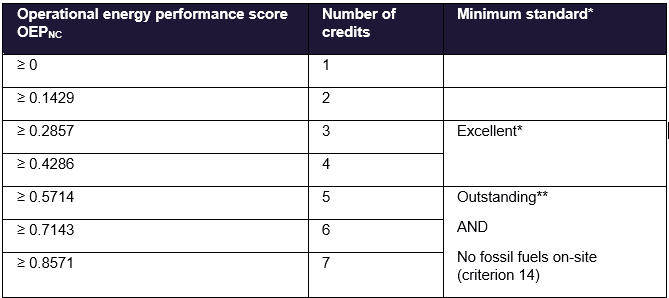 *Alternatively meet the minimum EPRNC score specified for Excellent in Ene 01.
**Alternatively meet the minimum EPRNC score specified for Outstanding in Ene 01.
*Alternatively meet the minimum EPRNC score specified for Excellent in Ene 01.
**Alternatively meet the minimum EPRNC score specified for Outstanding in Ene 01.
The OEP
NC scores required for each credit boundary have been lowered on the BREEAM platform in response to assessor feedback and an internal review of credit attainment against our benchmark database.
The table above supersedes:
- Table 28 in BREEAM International New Construction V7
- Table 6.3 in BREEAM UK New Construction V7
For further guidance on Ene 02 and the achievement of OEP
NC scores please refer to
KBCN1751 - GN53 Energy modelling and predicted operational energy performance score in Ene 02.
The above updated credit table will be included in the next reissue of the technical manuals
Prediction of operational energy and carbon – PHPP - KBCN1915
In applicable scheme versions (please see above), PHPP (Passive House Planning Package) will be considered as a compliant modelling approach for the prediction of operational energy (and carbon). This applies only to homes and small non-domestic buildings, where the building services are limited to:
- Heating
- Domestic hot water
- Natural or local mechanical ventilation
- Lighting and small power
- Solar photovoltaic or solar thermal systems
This methodology cannot be used where the building services include central air handling, mechanical cooling, or air conditioning.
Previously developed land – development footprint - KBCN1882
When determining the percentage of the proposed development that is on previously occupied land, the whole development footprint must be considered. This is defined as any part of the development that falls within the boundary of the assessed site (buildings, hard landscaping, car parks and access roads).
03-July-2026 Scheme applicability updated.
Public Transport Access Index (PTAI) – Buildings in Greater London - KBCN1149
For projects in Greater London, the Public Transport Access Index (PTAI) should be derived directly from the TfL WebCAT platform. When this tool is used, the BREEAM Tra 01/02 PTAI/AI calculation is not required.
Requirements:
- Baseline: Assessors must use the PTAL version that is current at the time the Transport Assessment is undertaken (Concept Design).
- Post-Construction Consistency: Once the design-stage PTAI is established, it does not need to be updated at the Post-Construction stage, even if the local transport network or WebCAT data has changed in the interim.
- Location: Access data via TfL WebCAT.
- Procedure: Follow the below technical guide to extract the specific Accessibility Index (AI) value from the WebCAT CSV export (Cell G3) for entry into the BREEAM Platform.
Locating-PTAI-via-TfL-WebCAT
04 03 2026 - Updated to clarify requirements and adding instruction for locating PTAI or AI via TfL WebCAT
03 08 2022 - Updated to clarify that the version used must be current at the time of the transport assessment, but this does not need to be updated at post-construction stage
Quantifying change in ecological value- Biodiversity metric rules - KBCN1894
Unless otherwise stated in the BREEAM technical manual, all rules of the methodology in the relevant user guide of the biodiversity metric must be followed in order for any credits to be awarded for the biodiversity net gain calculation. This includes rules such as trading rules, unit conversions, and competency requirements.
Restricted movement within a secure perimeter - KBCN000009
Where the movement of pedestrians, cyclists and vehicles is tightly controlled within a secure perimeter due to security considerations, these areas do not need to strictly meet the safe access criteria. However, justification and evidence provided by an appropriate member of the project team must demonstrate how the layout, measures and secure nature of the site result in a safe environment for cyclists, pedestrians, and vehicle access, in line with intent of each criterion.
Where a criterion is not applicable due to the secure nature of the site, this should be noted and justified in the assessment report.
24 May 2024 - New guidance introduced to ensure that safe pedestrian, cycle and vehicle movement is considered, even on secure sites with restricted movement.
* As this is a significant change, for any registered assessments where the assessor demonstrates that they have already advised the project team based on the previous guidance, the assessment can continue on that basis.

08 Jun 2022 Applicability to UK NC2018 confirmed
Reused in situ – Definition - KBCN1902
A material qualifies as reused in situ where it meets all of the following:
- It is removed from its original position or original application within the building.
- It undergoes no more than minor processing that does not alter its fundamental nature (e.g. cleaning, cutting, fixing to other materials).
- It is reinstalled in a different position or a different application within the building (or reused elsewhere within the project).
Exclusion
Materials that remain in their original location and application throughout the works, including where they undergo minor processing such as cleaning, repair or redecoration, are considered as retained. These must be excluded from the Mat 03 calculator.
KBCN Reinstated 24-Sep-2026
Safe access criteria requirements – Small infill developments and extensions - KBCN0810
For smaller infill developments (typically those with a total gross floor area of less than 1,000m
2) where there is no opportunity to make changes to the surrounding site or access to the building itself (other than those directly related to connecting building access points to existing pathways etc.), it is recognised that full compliance with the BREEAM criteria for safe access may not be achievable. This applies to developments where either:
- the assessed building lies within an existing site or campus under single ownership or
- the assessed building is an extension to existing buildings within an existing site or campus
In such instances the existing site layout should undergo a risk assessment against the BREEAM 'Safe Access' criteria to identify areas where there is potential for enhancement across the site. The findings should be reported to the client and design team and any non-compliant aspects should be resolved as far as practically possible within the scope of the project, however there is no express requirement to achieve full compliance in every respect. Where the assessor is satisfied that the above requirements have been met, the credit for 'Safe access' can be awarded.
31/03/17 Reference to achieving 'Security' credit removed
17/12/24 Applicability updated to include UKNC 2018 and V6
Scheme classification for residential projects (UK) - KBCN1225
Choosing the right scheme for developments is the starting point to ensure successful outcomes and value, in terms of quality and sustainability to building owners and for occupants of the building.
In light of the release of Home Quality Mark (HQM) ONE we have reviewed the existing guidance around scheme classifications of new build residential buildings and have removed ‘GN03 – Scheme Classification – Domestic buildings’ from BREEAM Projects.
When GN03 was written, the Code for Sustainable Homes (CSH) did not fully consider communal areas within residential blocks as part of the assessment. CSH was also not applicable in Scotland. GN03 was developed to clarify the differences between BREEAM Multi-Residential, CSH and EcoHomes, and when each scheme should be applied.
There is now a clearer distinction between BREEAM Multi-residential and HQM and when these should be used. Ultimately, the determining factor for a scheme classification is now focused on the intent of the building and who is going to be the end user (as opposed to previous guidance which considered aspects such as percentage of communal areas, etc.). Broadly, if the building’s main purpose is for long term homes then Home Quality Mark is the correct scheme to use.
Please use the following as guidance to identify the most appropriate scheme:
UKNCR / Home Quality Mark (HQM)
HQM has been designed with the occupant in mind. It assesses homes individually, but can also account for common areas associated with blocks of self-contained homes. HQM outputs (rating and indicators e.g. ‘my cost’, ‘my wellbeing’ and ‘my footprint’) are specifically aimed at those living in the home and are designed to better inform the occupant about the benefits of the home that they are purchasing or renting.
An HQM project will meet one or more of the following criteria:
Be designed to meet the function of a long-term self-contained home even though there may be some provision of communal facilities which can be used on a voluntary basis
Be classified under Building regulations Part L1a (i.e. required to complete SAP assessments, although there may be some linked SBEM assessed spaces associated with the project)
As such, HQM projects could be homes for sale, social housing or homes for rent (PRS and Built to Rent). They may also include some student and retirement/sheltered accommodation where the units are comparable to a normal self-contained flat/home.
BREEAM Multi-residential
For the purposes of BREEAM Multi-residential assessments, the term ‘multi-residential’ is used in the context of buildings that contain rooms for residential purposes alongside communal facilities for catering, leisure, care etc. These residential rooms would normally not have the full, self-contained functions of a home. This scheme usually covers more specialist residential care homes, student halls of residence, and other more communal accommodation. The scheme can cater for a small number of self-contained dwellings where these form part of a larger multi-residential development (e.g. on-site warden homes etc.). Under this scheme, the project is assessed on a whole building basis and as such does not seek to reflect the performance of individual residential units/rooms.
A BREEAM Multi-residential project will meet one or more of the following criteria:
Be provided for transient /non-permanent occupants
Provide suitable accommodation for occupants requiring support from carers, wardens or similar
Include shared living spaces
Be classified under Building regulations Part L2a (i.e. required to complete SBEM assessments, but can account for some SAP assessed spaces where associated with the project)
As a rule of thumb, if the building contains
rooms rather than self-contained flats or homes, a BREEAM Multi-residential assessment would probably be most appropriate. We are aware of some confusion over the meaning of the term ‘multi-residential’ in this context and will be considering the use of term as part of the next review of the BREEAM Multi-Residential scheme.
If you are unsure of the appropriate scheme classification for a particular project, please contact the BREEAM office before registering the project.
11-Nov-2025 - Applicability to current UKNC, HQM and UKNCR confirmed
Security rating scheme – SABRE update - KBCN1767
BRE’s partnership with the Security Institute for SABRE certification ends on 31 August 2025. From this date, SABRE will no longer be offered by The Security Institute.
The following guidance applies to projects targeting the security rating scheme criteria:
Ongoing and Registered Projects
Projects with existing or ongoing SABRE involvement may continue to pursue exemplary level credit using SABRE, provided that registration and certification activities occur before 31 August 2025. It is the responsibility of the project team to ensure that any SABRE-related assessments and certifications are completed and documented within the support window, in line with the BREEAM certification timeline.
New Projects (post 31 August 2025)
BRE is actively monitoring the market; however, no alternative schemes have been reviewed or accepted in place of SABRE.
However, whilst the exemplary credit may no longer be available via the SABRE route, project teams wishing to achieve an improved level of security for a development may still seek to engage with a SABRE professional and integrate the principles of the scheme into their design.
Key Implications:
The Security rating scheme, exemplary credit remains available; however, assessors must:
- Propose an alternative, equivalent risk-based security rating scheme, and
- Submit the scheme for review via the BREEAM Technical Query process.
Acceptance of alternatives will be based on whether the proposed scheme demonstrates:
- Third-party verification
- Structured risk-based assessment
- Defined performance standards
- Relevance to the development stage and typology
Site wide approach to ecological enhancements - KBCN1194
A site-wide approach to ecological enhancements can be used on sites where multiple buildings share areas of soft landscaping. The enhancement benefits are applied to the individual building assessments within the site. The benefit can be applied on a site-wide basis provided all developments are completed within the appropriate timeframe of a valid ecological survey.
16-Apr-2026 - Applicable to NC V7
30-Oct-2025 - Applicable to HQM V6 and UKNCR V6.1
Statutory Biodiversity Metric – Lowest percentage score - KBCN1773
When the Statutory Biodiversity Metric is used to calculate how many credits are awarded for an issue, the output with the lowest percentage score of the three outputs (habitats, watercourses and hedgerows) is used. In cases where the SQE has confirmed that there is no opportunity to enhance or create new habitat to increase the score, this requirement can be relaxed for the hedgerow and watercourse metrics (as these are usually those that are more difficult to compensate for).
This exception is only applicable if on-site enhancement is used exclusively. If off-site enhancement is used, then the output with the worst score should be used.
Submission of LCA Evidence - KBCN1916
Background
The Mat 01 embodied carbon tables previously used within the BREEAM platform for submitting embodied carbon results have been removed. Feedback from assessors indicated that the tables were difficult to complete accurately and created unnecessary friction in the assessment process.
Change
Assessors are no longer required to manually populate LCA data into platform tables. Instead, the LCA results Excel output generated automatically by the approved LCA software (the LCA template) should be uploaded directly to the platform as the supporting evidence.
Guidance
To achieve credits for a given lifecycle stage, assessors must confirm within the platform that:
- The LCA for that lifecycle stage has been completed, and
- The LCA has been reported.
Confirming both of these will reveal three input fields, into which the corresponding results from the embodied carbon calculations should be entered directly:
- GWP Biogenic A1-3 Sequestered and B5 Sequestered
- GWP Total A1-5, B1-5, C1-4
- Module D
Where benchmark credits are in scope, the total embodied carbon figure used for assessing these credits will be pulled automatically from the last lifecycle stage for which an LCA has been completed.
Submitting aftercare & post occupancy evaluation data - KBCN0589
Where credits have been awarded which require post-occupancy evaluation or an element of aftercare data collection (according to scheme requirements) from the building once operational and occupied, the data gathering must take place at the specified time and the findings reported to BRE.
The timing of this evidence gathering depends on the criteria of the specific BREEAM scheme. However, for all schemes, once the evidence is due for submission, it should be sent on the
assessor webform with the following subject;
'
BREEAM Assessment Type - Building Data -
BREEAM Assessment Reference'
For example:
'BREEAM NC 2018 - Building Data - BREEAM-1234-5678'
29-Oct-2025 - Applicable to HQM One, HQM V6 and UKNCR V6.1
05 Nov 2024 - Wording clarified and link to the webform added
This replaces KBCN0695 for HQM.
Suitably Qualified Acoustician – Associate membership of the Institute of Acoustics - KBCN00064
Associate membership of the Institute of Acoustics (IOA) can be considered to demonstrate that the individual is a member of an appropriate professional body.
This supersedes previous guidance on this matter, which has been updated following confirmation from the IOA that ‘Associate members’ are bound by the same Members’ Code of Conduct as ‘Full members’.
06/06/2022 - BRE stance on this has been revised - Title also updated for clarity
13/01/2020 Wording clarified and confirmed applicability to Issue Pol 05
06/01/2020 Clarification that this applies to BREEAM UK NC2018
Suitably qualified third-party verifiers – LCA training courses - KBCN1909
Purpose
Mat 01 requires the third-party verifier to demonstrate knowledge of the LCA sector, including relevant standards, EPD programmes and regulations (see Definition: Suitably qualified third party).
Examples of relevant LCA training courses
Below are examples of training courses that BRE considers as meeting this knowledge requirement, and which can support assessors and verifiers in evidencing compliance:
This list is illustrative, not exhaustive. Completion of one of these courses is one way to evidence the knowledge requirement. It does not replace the other criteria under Suitably qualified third party. Equally, a verifier who has not completed one of the above courses may still qualify if they can otherwise demonstrate the required knowledge.
Requesting an addition to this list
Training providers or assessors wishing to propose a course for inclusion should contact breeam@bregroup.com and include BREEAM Relevant LCA training course – addition request in the Subject field.
24-Sep-2026 - KBCN reinstated
Thermal comfort – Time-critical requirement - KBCN1801
The requirement for the full dynamic thermal analysis at detailed design stage, is set as this is the optimal stage to achieve the required sustainability outcome. When undertaken at a later stage, opportunities may be missed, options reduced or costs may become prohibitive. therefore the stipulated timeframes for such actions must generally be adhered to. However, if, due to specific circumstances or a non-standard the procurement route being used, the assessor can demonstrate that the aim of the criteria can still be fully met, despite the project having moved into a subsequent work stage, this will be accepted by BREEAM.
In such cases, the assessor must justify and demonstrate that the ability to fully meet the aim of the criterion has not been compromised.
Ventilation – Filtration – Non-residential assets - KBCN0797
Relevant specialist required
The design and specification of air filtration for mechanical ventilation requires the input and review of a relevant ventilation designer or specialist. It is their responsibility to interpret the requirements of this KBCN to align with local conditions.
Referenced standard
The requirements for air filtration in mechanical ventilation systems follows EN 16798-3:2017 Section B4.2. This standard replaces EN 13779:2007. See
KBCN1054.
Supply air quality
- For assessments using current standard EN 16798-3:2017 Section B4.2: The minimum supply air quality required is SUP2.
SUP 2 applies unless the asset's function dictates even higher supply air quality. Please refer to a relevant specialist for further advice.
- For assessments using legacy standard EN 13779:2007 Annex A3: The default minimum indoor air quality category required is IDA2.
For international assessments where there is no relevant local guidance in the ASWL, the default non-domestic ventilation rates stated in the ASWL equate to an EN 13779 indoor air category of IDA2.
Outdoor air quality
The filtering required to achieve SUP2 is affected by outdoor air quality. Outdoor air quality (ODA) in both EN 16798-3:2017 and EN 13779:2007 are defined as:
- ODA 1: outdoor air that meets World Health Organisation (WHO) guidelines or national air quality standards.
- ODA 2 exceeds ODA 1 levels by factor of ≤1.5.
- ODA 3 exceeds ODA 1 levels by factor > 1.5.
As ODA definitions are relative to national air quality standards, these will depend on local regulations and the location of the asset. Please refer to the relevant specialist on how to correctly classify ODA for your asset.
Where multiple pollutants or outdoor air intake locations result in different ODA categories, the overall classification for the asset should be based on the highest (worst-case) ODA category applicable.
27-Feb-2026 Note added to clarify the approach where more than one ODA category is applicable.
18-Nov-2022 Title amended to differentiate between residential and non-residential filtration KBCNs.
06-Sep-2022 KBCN re-written and re-named to clarify BREEAM ventilation filtration requirements in relation to new ventilation standards. Scheme applicability updated.
Ventilation – Single room MVHRs - KBCN1042
Single room mechanical ventilation heat recovery units do not need to show that the air intake and exhaust are a suitable distance apart.
However, the air intakes of these units must be located to minimise intake of other potential external pollutants.
11-Oct-2022 - Title amended for clarity and consistency. Wording simplified. Scheme applicability updated.
Verification of Security Needs Assessments/Security Risk Assessments - KBCN1770
Where the author of a Security Needs Assessment [‘Security Risk Assessment’ in BIU] does not meet the BREEAM competency requirements, compliance can still be achieved where the report is reviewed and verified by a qualified SQSS [‘Competent Person’ in BIU], who confirms in writing that it is accurate, appropriate and in line with industry best practice.
In these circumstances, the SQSS or ‘Competent Person’ is expected to verify and take ownership of the report and accept professional responsibility for its content.
View out – communal lounges, living rooms and bedrooms - KBCN1828
The default criteria for these space types requires relevant positions to be within 5m of an opening.
Where larger spaces are ≥ 50m2 NIA, the standard view out criteria for the relevant scheme is applied instead.
The 5m rule is intended for small scale domestic spaces where proximity to a view out is beneficial. This KBCN recognises that for larger relevant spaces in Residential, Multi-Residential and Residential Institution asset types, a scalable approach in line with commercial buildings is more appropriate.
View out – eye level - KBCN0581
BREEAM defines an adequate view out as being at seated eye level (1.2 – 1.3m) within the relevant building areas. However, where occupants will not have the option to be seated, for example in some industrial operational areas where the work being undertaken requires occupants to remain standing, the height of the view out can be changed accordingly to suit the eye level of occupants. All other view out requirements have to be met and clear justification provided for changing the height/level of the view out.
In some relevant building areas, occupants may not be sitting down to undertake tasks. Allowing the view out height requirements to be changed accordingly ensures building occupants gain maximum benefit from the view out.
VOC credit issues – Clarification of scope - KBCN1797
The scope of these requirements does not include furnishings or moveable furniture, e.g. desks, seats or shelving.
It includes fixtures and fittings that are integral to the building, such as kitchen units and toilet cubicles. However, bespoke fixtures, such as purpose-made items of fixed furniture, can be excluded, as the specified compliance testing is not appropriate for such items.
Weather files – 2020s, 2030s and 2050s - KBCN0842
Timescale
The weather files for each decade cover a 30-year climatic period around that decade.
For example, 2020s weather files cover the period 2010 to 2040. 2020s are in the middle of the three decades (10s / 20s / 30s).
NC - 2020s and 2050s
New Construction projects assessed under the relevant standards should continue to use the 2020 weather files for mechanical ventilation, and the 2050 weather files for natural ventilation.
CIBSE weather files are available here:
CIBSE Weather Data
RFO - 2030s and beyond
When published, the original intent for RFO projects was for future thermal comfort to be based on projected climate change 15 years after completion.
- For projects completed between 2015 and 2025, the 2030s data may still be used. This can be found here: Prometheus weather data.
- For projects completing after 2025, use CIBSE weather data covering the 2040s (included within the 2050s data): CIBSE Weather Data.
NOTE: For BREEAM standards published before September 2025, the 2016 CIBSE Weather Data may still be used.
15-Oct-2025 - Note added to clarify version requirements for CIBSE weather data.
08-Jan-2024 - Added clarification on RFO 2030s data.
18-Dec-2024 - Merged with KBCN000006. Prometheus link updated. Title updated.
04-Jul-2024 - Clarified that 2020 and 2050 weather files are still valid for the applicable standards and guidance applied to all relevant UK standards. Applicability to international standards removed and link to CIBSE weather data added.
19-Sept-2025 - Applicability to RFO projects added.
Zoning and occupant control – access to lighting controls - KBCN00032
The relevant areas for the criteria apply only to areas where users are expected to have control.
For instance, this means that areas intended for the general public, or a shop floor would not be expected to have lighting controls.
The general principle which applies to user access to general environmental controls (heating, cooling, ventilation) may also apply to access to lighting controls. See
KBCN0170.
However, the the exact approach may differ between the two types of systems and assessor judgement must be used to determine compliance.
In all cases zoning is required in all areas of the asset where specified in the assessment criteria. Please refer to the specific requirements of the applicable BREEAM standard to interpret this guidance appropriately.
14-Dec-2022 - KBCN applicability updated to include BIU. Wording updated. Link to KBCN0170 created.
Zoning and occupant control – control via BMS - KBCN0703
Occupant control via a BMS is not normally considered a compliant BREEAM solution. Any solution that requires the action of a third party (e.g. facilities manager) is not considered under the control of the occupant. Solutions where all relevant building occupants have control via a user-interface via BMS may be considered compliant where the assessor is satisfied that the aim of the criteria are met.
User-control must be available directly to the occupant.
21-Jul-2026 - Applicability updated
01-Aug-2017 - KBCN applicability to Thermal comfort Issue removed.
Zoning and occupant control – PIR detection systems - KBCN0335
The aim of the Health & Wellbeing category is to recognise ways to benefit occupants through giving them control of their lighting environment. Without manual overrides, presence or absence detection lighting controls (such as PIR detection systems) are not compliant with the criteria.
BREEAM recognises the energy efficiency benefits of detection systems in buildings through the Energy category. In some cases, the design team may have to prioritise one particular lighting strategy to the detriment of achieving a credit elsewhere.
17 09 2024 Updated to apply to BIU Part 1 - Lighting Controls
28 04 2021 Wording amended to include absence detection systems.
18 09 2017 Wording amended to clarify the meaning.
Information correct as of 29thSeptember 2026. Please see kb.breeam.com for the latest compliance information.