
New Construction / International / V7 / 03 - Energy /
Ene 02 - Prediction of operational energy and carbon
Information correct as of 19thOctober 2026. Please see kb.breeam.com for the latest compliance information.
Assessment of multiple buildings within a single BREEAM assessment - KBCN1836
Ene01, Ene02 and Wat01, which use area-weighted performance scales, must be assessed using the methodology set out below where multiple buildings are included within the scope of a single BREEAM assessment, including where:
• the Similar Buildings approach is applied, in accordance with Section 4 of GN20; or
• Separate buildings with a single overarching function are located on the same site, in accordance with Section 6 of GN20 (e.g. a principal building with one or more ancillary or supporting buildings).
Ene01
For UK NC projects, energy models (BRUKL files) must be uploaded for each building included within the assessment.
For International NC projects, the assessor must enter floor area-weighted average values for the relevant energy performance metrics for both the actual building(s) and the reference building(s), covering all buildings and applicable building uses included in the assessment.
Ene02
All buildings included within the assessment must be modelled in accordance with the methodology. The energy performance score must be calculated using floor area-weighted metrics covering all buildings, and compared against a benchmark derived from a floor area weighted average of all building types included within the assessment.
Wat01
For Wat01, the assessor must enter details for all water-using components across all buildings included within the assessment. The Wat01 benchmark is determined using a floor area-weighted occupancy by building type, covering all buildings within scope of the BREEAM assessment.
GN53 Energy modelling and predicted operational energy performance score in Ene 02 - KBCN1751
Latest version: v0.2, February 2026
Guidance Note 53 (GN53) provides guidance for the predictive energy modelling and predicted operational energy performance score credits within Ene 02, detailing the input process for the issue’s operational energy calculator.
Download Guidance Note 53
View all Guidance Notes on BREEAM Projects (licensed assessors only)
16-Feb-2026 - Updated for release of GN53 0.2
Predicted operational energy performance score – Credit table update - KBCN1825
From 4
th February 2026, the following credit table applies to Ene 02 in all BREEAM International New Construction V7 and BREEAM UK New Construction V7 assessments:
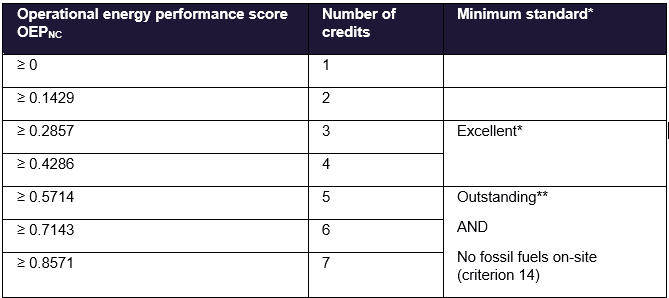 *Alternatively meet the minimum EPRNC score specified for Excellent in Ene 01.
**Alternatively meet the minimum EPRNC score specified for Outstanding in Ene 01.
*Alternatively meet the minimum EPRNC score specified for Excellent in Ene 01.
**Alternatively meet the minimum EPRNC score specified for Outstanding in Ene 01.
The OEP
NC scores required for each credit boundary have been lowered on the BREEAM platform in response to assessor feedback and an internal review of credit attainment against our benchmark database.
The table above supersedes:
- Table 28 in BREEAM International New Construction V7
- Table 6.3 in BREEAM UK New Construction V7
For further guidance on Ene 02 and the achievement of OEP
NC scores please refer to
KBCN1751 - GN53 Energy modelling and predicted operational energy performance score in Ene 02.
The above updated credit table will be included in the next reissue of the technical manuals
Prediction of operational energy and carbon – PHPP - KBCN1915
In applicable scheme versions (please see above), PHPP (Passive House Planning Package) will be considered as a compliant modelling approach for the prediction of operational energy (and carbon). This applies only to homes and small non-domestic buildings, where the building services are limited to:
- Heating
- Domestic hot water
- Natural or local mechanical ventilation
- Lighting and small power
- Solar photovoltaic or solar thermal systems
This methodology cannot be used where the building services include central air handling, mechanical cooling, or air conditioning.
Information correct as of 19thOctober 2026. Please see kb.breeam.com for the latest compliance information.