
New Construction / International / V7 /
01 - Management
Information correct as of 19thOctober 2026. Please see kb.breeam.com for the latest compliance information.
Capital cost reporting and LCC measured area - KBCN0438
When assessing the Capital cost reporting and the LCC credits, the area to be considered should be the Gross Internal Floor Area (GIFA), according to the below
RICS definition:
Gross Internal Floor Area
Gross Internal Floor Area is the area of a building measured to the internal face of the perimeter walls at each floor level, which includes:
- Areas occupied by internal walls and partitions
- Columns, piers chimney breasts, stairwells, lift-wells, other internal projections, vertical ducts, and the like
- Atria and entrance halls with clear height above, measured at base level only
- Internal open sided balconies, walkways, and the like
- Structural, raked or stepped floors are treated as a level floor measured horizontally
- Horizontal floors with permanent access below structural, raked or stepped floors
- Corridors of a permanent essential nature (e.g. fire corridors, smoke lobbies, etc.)
- Areas in the roof space intended for use with permanent access (BCIS)
- Mezzanine areas intended for use with permanent access
- Lift rooms, plant rooms, fuel stores, tank rooms which are housed in a covered structure of a permanent nature, whether or not above main roof level
- Service accommodation such as toilets, toilet lobbies, bathrooms, showers, changing rooms, cleaners’ rooms and the like
- Projection rooms
- Voids over stairwells and lift shafts on upper floors
- Loading bays
- Areas with a headroom of less than 1.5m
- Pavement vaults
- Garages
- Conservatories (BCIS)
And excludes:
- Perimeter wall thickness and external projections
- External open-sided balconies, covered ways and fire escapes
- Canopies
- Voids over or under structural, raked or stepped floors
- Greenhouses, garden stores, fuel stores and the like in residential property
- Open ground floors and the like (BCIS)
14.02.18 - KBCN content amended to extend the applicability to LCC and to refer to GIFA rather than GEA, to reflect current industry practice.
Changes to CCS – May 2026 – For BREEAM V7 - KBCN1873
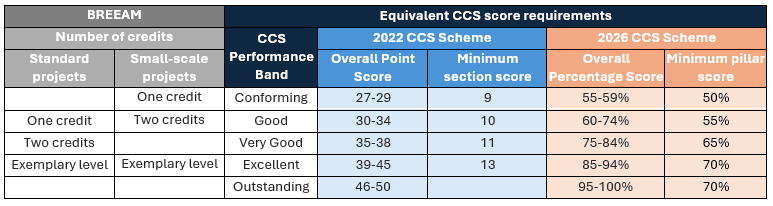
In response to the 2026 update to the Considerate Constructors Scheme (CCS), the equivalent CCS score requirements for achieving credits are set out in the orange columns of the table below. Credits will be awarded based on the site’s average performance across all visits, as reported on the final certificate.
Where a project has received site inspections under both the previous and updated versions of the CCS scheme, the higher score may be used to determine credit achievement. For example, where a project achieved an Excellent rating under the 2022 CCS scheme but a Very Good rating under the 2026 CCS scheme, the higher (Excellent) rating can be used.
This approach ensures that projects are not disadvantaged during the transition between CCS versions.
Whilst the platform is being updated to include the new CCS percentage scores within the question drop-downs, please select the equivalent CCS 2022 Scheme score to award credits.
Elemental LCC and options appraisal timing - KBCN1889
The elemental LCC should be undertaken as part of the strategic options appraisal process and used to inform the selection of significant building elements and systems, such as the structure, envelope and building services. Completing the options appraisal after key design decisions have been finalised may reduce its effectiveness and limit the opportunity for the findings to influence the final design.
However, the timing requirement can still be met, where the assessor agrees that there is a justification for the appraisal continuing into early AIA Stage 2 - Schematic Design (or equivalent), and clear evidence to demonstrate that:
- The key options remained under consideration during the appraisal.
- The findings were capable of influencing the final design solution.
- The intended outcomes of the elemental LCC process have not been compromised.
In all cases, the outline elemental LCC plan and identification of relevant project options must be completed by the end of Concept Design
Erratum – Monitoring utility consumption – Meeting the set targets - KBCN1899
The target and actual total energy and water consumption figures must be entered into the platform. However, meeting the targets is not required for compliance. The relevant criteria will be clarified in the next reissue.
KBCN Reinstated 24-Sep-2026
GN54 Responsible construction management – BREEAM V7 - KBCN1752
Latest version: v1.0, July 2026
Guidance Note 54 (GN54) provides information on achieving the responsible construction management requirements in Man 03 in BREEAM V7.
It has two parts:
- Part 1 lists the requirements that must be met to achieve credits for responsible construction management in BREEAM V7.
- Part 2 provides a list of the schemes or tools that have been evaluated by BREEAM and can contribute to the achievement of one or more credits for responsible construction management.
This guidance note only applies to BREEAM V7. There is a separate guidance note for earlier versions of BREEAM UK NC and UKNCR (see
Guidance Note 33).
Download Guidance Note 54
View all Guidance Notes on BREEAM Projects (licensed assessors only)
15-Jul-2026 - Updated version released (v1.0)
Legally harvested and traded timber – Examples - KBCN0956
The following examples are considered compliant for BREEAM purposes.
Legally harvested:
- Evidence of compliance with the CPET (see here, timber bought inside the UK only)
- FSC, PEFC or SFI certification
- Evidence of compliance with the EUTR (timber bought inside the EU only)
- ASTM D7612-21 (projects in USA and Canada)
- Risk assessment/due diligence documentation demonstrating a low risk of non-compliance with the ‘legally harvested’ requirements given in the manual.
Legally traded:
- Evidence of compliance with the CPET (see here, timber bought inside the UK only)
- FSC, PEFC or SFI certification
- ASTM D7612-21 (projects in USA and Canada)
- Risk assessment/due diligence documentation demonstrating a low risk of non-compliance with the ‘legally traded’ requirements given in the manual.
17-Dec-2025 Reference to ASTM D7612-21 added
Meeting the minimum standard requirement – compliance when chain of custody is broken - KBCN1816
Where there is a broken chain in the last link between the purchase and delivery of certified timber from the supplier and the forwarding distribution of the timber to the site under assessment, such as where the timber has been delivered to a subcontractor or fabricator’s premises instead of direct to site (e.g. as part of a bulk order or where limited storage is available on site), compliance can still be achieved if a documented risk assessment confirms that there is
low risk of mixing or substitution of certified and non-certified timber.
Ways to demonstrate compliance:
A. Verification that the subcontractor or fabricator only purchases and uses certified timber.
There must be robust mechanisms in place to verify that all timber materials purchased and delivered originate from sustainably managed sources. This includes maintaining documented timber procurement policies and procedures that mandate certified timber orders and delivery checks. Comprehensive supplier details should be readily accessible for review upon request to demonstrate that all timber is certified.
B. Where non-certified timber is handled/stored or sourced, that there are robust control measures in place to prevent any substitution or mixing of certified and non-certified timber at every stage of the process.
Documentation demonstrating compliance should be maintained and made available upon request. Examples of appropriate control measures are listed below:
Control
|
Evidence required
|
| Purchasing records |
All purchase orders, requisition notes, and contracts must explicitly specify the product details and confirm that materials are to originate from legal and sustainable sources. |
|
Segregated storage of timber
|
Site layout map, stock control processes and records to confirm that certified timber is stored away from non-certified timber. |
| Segregated delivery of timber to site |
- All timber must be thoroughly inspected and verified before shipment to confirm that it is correctly marked/labelled as FSC/PEFC-certified.
- Delivery notes must be accurately maintained.
- A second-party verification process to check tickets and stock, must be carried out upon site delivery to confirm certified status of timber. |
| Documentation |
Comprehensive documentation must enable independent assessors to trace any timber back to its sustainable source. This includes maintaining purchase records, goods-inward notices, stock records, and sales documentation such as orders and invoices. |
The above is guidance and should not replace any local or national requirements for the sourcing of legally traded and harvested timber.
1 June 2026 - Updated to apply to New Construction and RFO Schemes
Submitting aftercare & post occupancy evaluation data - KBCN0589
Where credits have been awarded which require post-occupancy evaluation or an element of aftercare data collection (according to scheme requirements) from the building once operational and occupied, the data gathering must take place at the specified time and the findings reported to BRE.
The timing of this evidence gathering depends on the criteria of the BREEAM scheme having been undertaken. However, for all schemes, once the evidence is due for submission, it should be sent to BREEAM@bre.co.uk with the following title;
'
BREEAM Assessment Type Building Data
BREEAM Assessment Reference'
For example, a BREEAM 2011 New Construction assessment would use the following title when submitting their evidence;
'BREEAM NC 2011 Building Data BREEAM-1234-5678'
This KBCN replaces KBCN0695 for HQM.
Information correct as of 19thOctober 2026. Please see kb.breeam.com for the latest compliance information.