
Within the BREEAM daylight criteria, there are two detailed calculation options of either using the average daylight factor method or average and minimum daylight illuminance method.
The use of the standards within the table below, can now be used as approved alternative calculation methods. The performance requirement must be met in line with either the standard or exemplary criteria as set out in the table below:
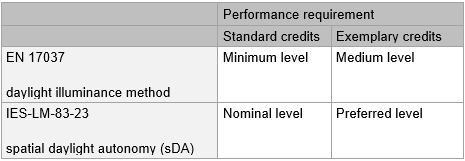
To use either the EN 17037 or IES-LM-83-23 option, the methodology within Guidance Note 50 must be followed. In addition, the minimum percentage area to comply, dependant on the building type and space type, must be met in accordance with the criteria within the relevant BREEAM issue. To calculate the percentage of assessed area that complies, follow KBCN0471 or KBCN1081.
Example:
A school using the International New Construction V6 scheme, has used the IES-LM-83-23 sDA method to calculate the daylight performance. The nominal level is achieved in all occupied spaces. The minimum area to comply is set at 80% as per table 10 and 12. As 100% of occupied spaces meet the nominal level, 2 credits can be met.