
New Construction / UK / V6 / 01 Management /
Man 03 - Responsible construction practices
Information correct as of 10thSeptember 2026. Please see kb.breeam.com for the latest compliance information.
BREEAM Advisory Professional (AP) – Retrospectively applying AP status - KBCN1080
The AP status cannot be applied retrospectively. The purpose of using an AP on a project is that they can advise and steer the development from the outset to maximise its BREEAM and sustainability performance for the least cost/risk. If early AP appointment and involvement does not occur then the aims and criteria of this BREEAM issue are not being met.
BREEAM AP – Change of BREEAM APs/Sustainability champions during project - KBCN0295
Whilst it would generally be preferable to retain the same individual in the role of BREEAM AP/Sustainability champion throughout the design and construction of a particular project for the purposes of continuity, we appreciate that this may not always be feasible. It is therefore entirely appropriate that the three credits available for using BREEAM APs/Sustainability champions can still be awarded where the individual performing the role changes (provided the ongoing involvement of an AP/SC is maintained in accordance with the criteria).
Certificate validity – EMS - KBCN1401
The requirement for the principal contractor to operate an EMS relates to the duration of operations on site. Certification against ISO 14001/EMAS must be valid at the Design Stage and Post Construction Stage submissions and cannot be expired, pending or applied retrospectively.
07/05/2021: Clarification on Design and Post Construction Stage added
Change in main contractor - KBCN0645
In situations where the main contractor changes mid-project, for example where the original contractor goes into administration and is replaced by another main contractor, it is acceptable for the post-construction credits to be awarded based on the new contractor providing information on their activities. This is providing the project is yet to start on site. This is in effect assessing the issue using the Post Construction Assessment route instead of a Post Construction Review.
However, if the project has already started on site and information about the site activities of the previous contractor is not available it would not be appropriate to award the credit solely based on the new contractor activities.
Changes to CCS – January 2022 - KBCN1500
UKNC2011, UKNC2014, RFO2014 and Domestic Refurbishment 2014 schemes:
In response to the 2022 changes to the structure and scoring in the CCS, the adjusted points for credits are as follows for each of the three new sections (Community, Environment, and Workforce):
One credit requires a minimum of
9 points per section and
27 overall.
Two credits require a minimum of
11 points per section and
35 overall.
Exemplary credit requires a minimum of
13 points per section and
39 overall.
UKNC2018, UKNCV6, HQM ONE and HQM V6 schemes and UKNCR V6.1:
No changes have been made to the criteria or the requirement to demonstrate compliance with items g, p and q for the exemplary credit.
GN33 has been updated to demonstrate the mapping of the updated CCS to these schemes, see
KBCN1215.
For assessments not following CSS, the criteria remain unchanged. More information on the changes to the CCS scheme are outlined on the CCS website.
29-Oct-2025 - Applicable to HQM V6 and UKNCR V6.1
12-Apr-2023 - Updated to clarify the applicability of the new guidance.
28-Feb-2023 - Note updated to refer to the updated version of GN33.
29-Apr-2022 - Note added to clarify that this information supersedes the requirements in the technical manuals.
25-Mar-2022 - Updated to provide the new scoring requirements for BREEAM standards.
Changes to CCS – May 2026 – For BREEAM 2018, V6, V6.1 and HQM - KBCN1872
In response to the 2026 update to the Considerate Constructors Scheme (CCS), the equivalent CCS score requirements for achieving credits are set out in the orange columns of the table below. Credits will be awarded based on the site’s average performance across all visits, as reported on the final certificate.
Where a project has received site inspections under both the previous and updated versions of the CCS scheme, the higher score may be used to determine credit achievement. For example, where a project achieved an Excellent rating under the 2022 CCS scheme but a Very Good rating under the 2026 CCS scheme, the higher (Excellent) rating can be used.
This approach ensures that projects are not disadvantaged during the transition between CCS versions.
Where using the 2022 CCS Scheme score, please refer to Table 2 of GN33 for the mapping of the CCS score against the Responsible Construction Management Checklist (items a–s), and provide any additional evidence as required (e.g. for items g, p and q for the exemplary credit).
When using the 2026 CCS scheme score, credits may be awarded based on the CCS score alone, in line with the table below.
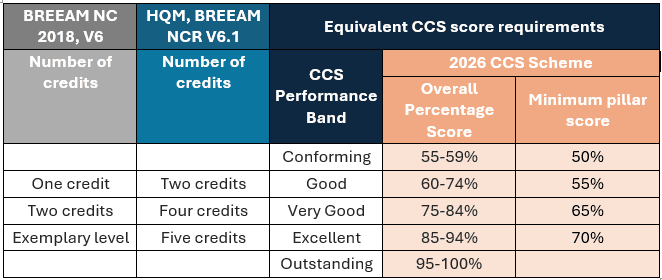
29 May 2026 - Table updated to align with credit award for HQM and NCR 6.1
Considerate Constructors Scheme – Phased developments - KBCN0328
The Considerate Constructors Scheme does make provision for phased developments within the registration process, allowing each phase to be registered separately. They make this provision to allow for very large developments that may go on over several years. It should therefore be possible for the developer to register the site in phases, so that CCS certificates can be submitted for BREEAM assessed buildings, without having to wait for the completion of the final phase.
Definition – NHS Buildings - KBCN1085
'NHS buildings' refers to projects which are primarily funded in the long term by the National Health Service.
'Prerequisite - For Healthcare NHS building only" applies to any facilities which are owned and managed privately but which source the majority of their income from the NHS.
Definition – Project value - KBCN0552
The term ‘project value’ represents the total project cost, which includes all costs such as construction, design, land acquisition, etc.
Environmental management – Timing of obtaining ISO 14001/EMAS certification - KBCN0229
The contractor must be in possession of the ISO 14001/EMAS certification prior to starting works on the development under assessment.
This is to ensure that the aim of the issue, to ‘encourage construction sites managed in an environmentally sound manner’, can be achieved. To uphold the robustness of BREEAM, the date of certification to ISO 14001/EMAS must be prior to initial works starting on the site.
Evidence requirements – responsible sourcing of materials at post-construction - KBCN1599
Whilst the UK BREEAM manuals are less prescriptive in the evidential requirements to allow flexibility, to ensure consistency across the schemes, it is expected that robust evidence should be provided to verify the source of any certified materials and how the assessor has confirmed the products and manufacturers used.
Evidence supplied at post construction stage must reflect the completed building and confirm the responsibly sourced materials that have been procured and installed on the project. Supporting documentation is required to validate letters of confirmation or schedules of materials.
Evidence provided could include proof of purchase, for example, invoices, delivery tickets, purchase orders or correspondence from suppliers. This may be an example for each material sourced, rather than every delivery ticket for instance. Alternatively, evidence of the use of the responsibly sourced materials may include as-built drawings, O&M documentation or site photographs.
30-Oct-2025 - Applicable to HQM V6 and UKNCR V6.1
Fleet operator definition – Responsible construction management items p and q - KBCN1473
The definition of the fleet operator states that “transportation to the project is likely to be by several fleet operators many of which will not be under the control of the constructor. The criteria relate to all fleet operators, nonetheless.”
Following feedback on the difficulties of applying the requirements to fleet operators who do not directly work with the contractor, these requirements will only apply to those who are under the control of the principal contractor.
‘Fleet operators’ should now, therefore, be read as ‘all vehicles used or present on site which are owned, leased or hired by the principal contractor’. For clarity this may include, but is not limited to:
- company vehicles (cars and vans)
- movable plant or powered equipment (such as dumpers, diggers, cranes)
- trucks, lorries or waste removal wagons
Item P should, therefore, read:
For any company vehicles or plant owned, leased or hired by the principal contractor; driver or operator training and awareness is undertaken to promote safety within the development footprint and off-site.
Item Q should read:
The principal contractor records, investigates and analyses any vehicular accidents, incidents and near misses; and learnings are incorporated in updated policies and training.
This will be amended in the next reissue of the technical manual and GN33.
26 September 2024: This has been updated to provide additional clarification on what is meant by fleet operators under the control of the principal contractor.
20 January 2025: Reference to HQM added.
FSC and PEFC Mixed Sources certified timber - KBCN00091
Products labelled:
- FSC Mix or
- PEFC Mixed Sources
Meet the BREEAM responsible sourcing requirements. This means any such products:
- In HQM, and in BREEAM NC 2016 or older schemes: meet the prerequisite for legally harvested and traded timber.
- In BREEAM NC 2018 or newer schemes: meet the prerequisite for legal and sustainable timber.
- In all schemes: can be used to demonstrate responsible sourcing.
Products carrying the FSC Mix label contain at least 70% FSC certified and recycled material. These products may contain a small proportion of FSC Controlled Wood (KBCN00054). However for BREEAM compliance, the FSC Mix label is sufficient to meet our requirements.
30-Oct-2025 - Applicable to HQM V6 and UKNCR V6.1
14-Mar-2024 - Wording clarified and expanded. Relevant prerequisites and requirements clarified. Scheme applicability updated.
FSC Controlled Wood - KBCN00054
The
FSC Controlled Wood label minimises the risk that wood comes from illegal or controversial sources, however it does not eliminate this risk.
Therefore, products which are:
- Labelled as FSC Controlled Wood or,
- Where the majority of material in a product is comprised of FSC Controlled Wood,
Do not meet the BREEAM definition of responsibly sourced.
Where FSC Mix labelled products contain FSC Controlled Wood, see KBCN00091.
This means that any such products:
- In HQM, and in BREEAM NC 2016 or older schemes: do not meet the prerequisite for legally harvested and traded timber.
- In BREEAM NC 2018 or newer schemes: do not meet the prerequisite for legal and sustainable timber.
- In all schemes: cannot be used to demonstrate responsible sourcing.
30-Oct-2025 - Applicable to HQM V6 and UKNCR V6.1
14-Mar-2024 - Wording clarified and expanded. Relevant prerequisites and requirements clarified. Scheme applicability updated.
GN33 – Evidence requirement clarification - KBCN1157
In
Guidance Note 33 (GN33), BREEAM recognised responsible construction schemes are mapped against the 'Responsible construction management' criteria within the manual, in order to determine the degree of comparability. Table 2 in GN33 provides a mapping of the recognised schemes, the relevant scores and the BREEAM items ‘a-s’ which are achieved.
Where items in the table have been 'ticked', the only evidence that is required is confirmation of the formal certification under the relevant scheme, in addition to the evaluation report. No further information is required to achieve these items.
Where an item in the table has been 'crossed', this means that either, the responsible construction scheme does not demonstrate compliance with that BREEAM item, or that the score achieved is not high enough to confirm compliance with the item. Where a cross exists against an item, additional evidence will be required to demonstrate compliance with those items, (where credits are sought).
29-Oct-2025 - Applicable to HQM V6 and UKNCR V6.1
28-Feb-2023 - Updated link for Guidance Note 33
GN33 has been updated - KBCN1282
Guidance Note 33 (GN33) has been updated with new mapping results following the 2022 update to the Considerate Constructors Scheme (CCS). A full description of the change can be found in the 'Schedule of changes' in GN33.
28-Feb-2023 - Updated to refer to latest version of GN33 (v2.0, February 2023). This KBCN previously referred to the changes in GN33 v1.1. The full change history can still be found in the 'Schedule of changes' in GN33.
GN33 Responsible construction management in BREEAM and HQM - KBCN1215
Latest version: v3.0, July 2026
BREEAM awards credits for responsible construction management to recognise and encourage construction sites which are managed in an environmentally and socially considerate, responsible and accountable manner.
Guidance Note 33 (GN33) lists the responsible construction management requirements in BREEAM and provides a list of recognised schemes and tools that may used to demonstrate that particular requirements have been met.
This guidance note only applies to:
- UK New Construction 2018, V6, V6.1
- UK New Construction Residential (formerly HQM) ONE, V6, V6.1
There is a separate guidance note for BREEAM V7 (see Guidance Note 54).
Download Guidance Note 33
View all Guidance Notes on BREEAM Projects (licensed assessors only)
15-Jul-2026 - Updated version released (v3.0)
Legally harvested and traded timber – Examples - KBCN0956
The following examples are considered compliant for BREEAM:
Legally harvested:
- Evidence of compliance with the UK government Timber Procurement Policy (see here, timber bought inside the UK only)
- FSC, PEFC, SFI or GiB certification
- Evidence of compliance with the EUTR (timber bought inside the EU only)
- Risk assessment/due diligence documentation demonstrating a low risk of non-compliance with the ‘legally harvested’ requirements given in the manual.
Legally traded:
- Evidence of compliance with the UK government Timber Procurement Policy (see here, timber bought inside the UK only)
- FSC, PEFC, SFI or GiB certification
- Risk assessment/due diligence documentation demonstrating a low risk of non-compliance with the ‘legally traded’ requirements given in the manual.
04-Dec-2025 - Examples updated to include Grown in Britain (GiB) certification. Previous reference to 'CPET' clarified as 'UK government Timber Procurement Policy'.
KBCN applied more widely to all relevant scheme issues in BREEAM and HQM
Legally harvested and traded/Legal and sustainable timber – Reclaimed/recycled timber - KBCN0654
Timber should, wherever possible, be sourced in accordance with the UK Government’s Timber Procurement Policy. However, if for reclaimed timber the original procurement details are unobtainable, robust evidence to demonstrate it has been reclaimed can be acceptable.
The government UK Government Timber Procurement Policy Timber Procurement Advice Note (6th edition) states:
As an alternative to demanding timber and wood-derived products from a Legal and Sustainable source, Contracting Authorities can demand ‘recycled timber’. Documentary evidence and independent verification will also apply to recycled timber and recycled wood-derived products but will focus on the use to which the timber was previously put rather than the forest source.
And defines ‘recycled timber’ as:
“…recovered wood that prior to being supplied to the Contracting Authority had an end use as a standalone object or as part of a structure and which has completed its lifecycle and would otherwise be disposed of as waste. The term ‘recycled’ is used to cover the following categories: pre-consumer recycled wood and wood fibre or industrial by products but excluding sawmill co-products (sawmill co-products are deemed to fall within the category of virgin timber), post-consumer recycled wood and wood fibre, and drift wood. It also covers reclaimed timber which was abandoned or confiscated at least ten years previously.”
As per the above policy, BREEAM requires “Documentary evidence and independent verification” that all reclaimed/recycled timber products meet the definition of ‘recycled timber’ given above.
01/06/2020: Amended to clarify and extended applicability to Mat 03
Pollution Prevention Guidance documents - KBCN1051
On 17 December 2015, the Pollution Prevention Guidance documents (PPGs) published by the Environment Agency were withdrawn. These can be found in the National Archives or on the Scottish Environment Protection Agency website where they are still current documents.
Many BREEAM schemes and the Home Quality Mark refer to these PPG documents as they are still considered to be best practice even though they have been withdrawn. Projects should continue to use the PPGs referenced in the relevant manuals.
BREEAM will continue to review this situation and provide an update as and when appropriate.
26 09 2018 Made applicable to Man 03 and Pol 03 in UK NC2018 and Man 03 in UK NC 2011, UK NC2014 and UKRFO 2014
Prerequisite – Reused temporary site timber - KBCN1769
Timber formwork or scaffold boards, that are being reused and are verified as such, can be excluded from the criteria.
It is more sustainable to reuse existing timber than to potentially promote the use of virgin timber just to ensure responsible sourcing paperwork is available, which may be logistically hard to obtain for reused timber.
Responsible construction management – corporate registration - KBCN1084
Where credits are awarded for the assessment of the site against a compliant scheme, corporate registration, which assesses the contractor's overall operations and performance across multiple sites, is not in itself recognised.
To award considerate construction credits, BREEAM requires the assessment of the specific assessed development, in line with the criteria
Responsible construction practices – Demolition or strip-out - KBCN1257
Demolition or strip-out undertaken by a previous site owner or by the current owner, as part of a significantly earlier site clearance
- Where it can be demonstrated that demolition was unconnected to the current development, the requirements of Man 03 do not apply to the demolition phase. This would typically be where demolition was undertaken prior to RIBA stage 0.
- Exceptions may also be considered where the demolition was expedited for health and safety reasons. In such cases, this should be fully justified and evidenced.
Demolition or strip-out undertaken by the current developer to enable the assessed development
- This must be included in the scope of the Man 03 issue. The site should be managed responsibly at all stages. The risks inherent in demolition and strip-out are as significant as during construction.
- This is indicated in the following guidance in the technical manual:
- The wording of Criteria 2-4
- Methodology: ‘Scope of the responsible construction management’
- Definitions: ‘Construction process’
- Demolition undertaken by a separate demolition contractor, prior to the principal contractor taking possession of the site
- All criteria are applicable.1 The demolition contractor is responsible for compliance.
- Where a BREEAM AP has not yet been appointed, Criterion 6 does not apply.
- Demolition undertaken by the principal contractor or by others when the principal contractor has control of the site
- All criteria are applicable.1 Responsibility is criteria-dependent.
1 Project scale
For smaller contractors/projects, for ‘Monitoring of construction site impacts’ and ‘Environmental management’, it may be acceptable to demonstrate that the intent of the criteria has been met for this stage of works, as far as possible. This should be proportionate to the scale and risks associated with the demolition or strip-out. In such cases, the approach should be fully justified and evidenced.
12 Jan 2022 Wording and title updated to clarify the intent.
Responsible construction practices – Multiple contractors on the same project - KBCN0352
It is the site that must comply with BREEAM issues rather than any individual contractor. Several different contractors may have obligations to meet compliance criteria. One of the contractors and/or site managers may have responsibility for ensuring compliance during site operations. It is ultimately the client/project team's responsibility to determine and demonstrate compliance.
Transport of construction materials – Data and methodology - KBCN0413
To ensure comparability across assessments, the information completed in the scoring and reporting tool should be restricted to the minimum data specified in the technical manual.
For the purposes of this BREEAM Issue, the distances reported should be calculated from the point from which the products or materials were sourced, whether this be directly from a manufacturer or from a builders' merchant/distributor:
- For products or materials purchased directly from a manufacturer or quarry, for example, the distance should be calculated from the ‘factory gate’, including any intermediate transport.
- For products or materials, which are purchased from a merchant or distributor, only the distance from their depot should be reported.
Where products cannot be sourced locally, for example on small islands, the transport required to import the materials or products can be discounted, and only the local onward transport to the site recorded.
The aim of this requirement is to encourage developers to consider the impacts of transporting products and materials to site. As such, the criteria seek to address only those impacts, which can be influenced by the developer.
27.07.2018 Wording amended to add clarity.
Utility consumption – units for project value - KBCN1469
When calculating the total kgCO₂/project value and entering this in the tool, the project value should be reported in pounds sterling i.e. kgCO₂/£1
Information correct as of 10thSeptember 2026. Please see kb.breeam.com for the latest compliance information.