
New Construction / UK / V6 / 06 Materials /
Mat 03 - Responsible sourcing of construction products
Information correct as of 25thOctober 2026. Please see kb.breeam.com for the latest compliance information.
Bamboo, cork and other non-timber forest products – Responsible sourcing - KBCN1768
Non-timber forest products, such as bamboo and cork should be responsibly sourced to minimise the environmental impacts and protect local ecosystems. However, as they are not timber or timber-based products, these fall outside the scope of the Prerequisite.
Where such products are integrated into a building, they should, nonetheless, be assessed and included in the calculator under ‘Other materials’.
Erratum – 2018 to V6 – scope – external doors - KBCN1651
The scope of this issue includes external doors.
Currently, external doors are missing from the Mat 03 scope 'internal finishes'.
This will be corrected in future versions.
Evidence requirements – responsible sourcing of materials at post-construction - KBCN1599
Whilst the UK BREEAM manuals are less prescriptive in the evidential requirements to allow flexibility, to ensure consistency across the schemes, it is expected that robust evidence should be provided to verify the source of any certified materials and how the assessor has confirmed the products and manufacturers used.
Evidence supplied at post construction stage must reflect the completed building and confirm the responsibly sourced materials that have been procured and installed on the project. Supporting documentation is required to validate letters of confirmation or schedules of materials.
Evidence provided could include proof of purchase, for example, invoices, delivery tickets, purchase orders or correspondence from suppliers. This may be an example for each material sourced, rather than every delivery ticket for instance. Alternatively, evidence of the use of the responsibly sourced materials may include as-built drawings, O&M documentation or site photographs.
30-Oct-2025 - Applicable to HQM V6 and UKNCR V6.1
FSC and PEFC Mixed Sources certified timber - KBCN00091
Products labelled:
- FSC Mix or
- PEFC Mixed Sources
Meet the BREEAM responsible sourcing requirements. This means any such products:
- In HQM, and in BREEAM NC 2016 or older schemes: meet the prerequisite for legally harvested and traded timber.
- In BREEAM NC 2018 or newer schemes: meet the prerequisite for legal and sustainable timber.
- In all schemes: can be used to demonstrate responsible sourcing.
Products carrying the FSC Mix label contain at least 70% FSC certified and recycled material. These products may contain a small proportion of FSC Controlled Wood (KBCN00054). However for BREEAM compliance, the FSC Mix label is sufficient to meet our requirements.
30-Oct-2025 - Applicable to HQM V6 and UKNCR V6.1
14-Mar-2024 - Wording clarified and expanded. Relevant prerequisites and requirements clarified. Scheme applicability updated.
FSC Controlled Wood - KBCN00054
The
FSC Controlled Wood label minimises the risk that wood comes from illegal or controversial sources, however it does not eliminate this risk.
Therefore, products which are:
- Labelled as FSC Controlled Wood or,
- Where the majority of material in a product is comprised of FSC Controlled Wood,
Do not meet the BREEAM definition of responsibly sourced.
Where FSC Mix labelled products contain FSC Controlled Wood, see KBCN00091.
This means that any such products:
- In HQM, and in BREEAM NC 2016 or older schemes: do not meet the prerequisite for legally harvested and traded timber.
- In BREEAM NC 2018 or newer schemes: do not meet the prerequisite for legal and sustainable timber.
- In all schemes: cannot be used to demonstrate responsible sourcing.
30-Oct-2025 - Applicable to HQM V6 and UKNCR V6.1
14-Mar-2024 - Wording clarified and expanded. Relevant prerequisites and requirements clarified. Scheme applicability updated.
GN18 BREEAM Recognised Responsible Sourcing Certification Schemes and BREEAM Scheme Applicability - KBCN0723
Latest version: v3.7, May 2023
BREEAM awards credits for responsibly sourcing construction products (typically under the Mat 03 issue) to encourage responsible product specification and procurement in construction. To achieve these credits, applicable specified products (as listed in the relevant technical manual) must be covered by an Environmental Management System (EMS) or a responsible sourcing certification scheme (RSCS) recognised by BREEAM.
Guidance Note 18 (GN18) lists the responsible sourcing certifications schemes recognised by BREEAM along with the relevant summary scores to be used in BREEAM assessments.
Download Guidance Note 18
Download Guidance Note 18 v2.0 (licensed assessors only - optional for projects registered prior to release of v3.0 in September 2016)
View all Guidance Notes on BREEAM Projects (licensed assessors only)
21-Jul-2026 - Applicable to NC V6, NC V7, RFO V7
GN24 Demonstrating compliance with responsible sourcing requirements in BREEAM - KBCN0721
Latest version: v1.2, July 2026
Guidance Note 24 (GN24) provides additional guidance to assessors and specifiers on demonstrating compliance with the 'Measuring responsible sourcing' criteria in BREEAM (typically in Mat 03). It should be read in conjunction with the Technical Manual for the relevant assessment scheme. It covers:
- How to deal with constituent products/materials including those with certification that is different from the overall product.
- The precision required in estimating quantities:
- For the cut-off volume
- Of products/materials in the building (Route 2 only)
- Of different material categories in products/materials.
- An example Route 2 calculation.
- ‘Broken chain’ situations.
- How to treat building services.
Download Guidance Note 24
View all Guidance Notes on BREEAM Projects (licensed assessors only)
15-Jul-2026 - Updated version released (v1.2)
Legally harvested and traded timber – Examples - KBCN0956
The following examples are considered compliant for BREEAM:
Legally harvested:
- Evidence of compliance with the UK government Timber Procurement Policy (see here, timber bought inside the UK only)
- FSC, PEFC, SFI or GiB certification
- Evidence of compliance with the EUTR (timber bought inside the EU only)
- Risk assessment/due diligence documentation demonstrating a low risk of non-compliance with the ‘legally harvested’ requirements given in the manual.
Legally traded:
- Evidence of compliance with the UK government Timber Procurement Policy (see here, timber bought inside the UK only)
- FSC, PEFC, SFI or GiB certification
- Risk assessment/due diligence documentation demonstrating a low risk of non-compliance with the ‘legally traded’ requirements given in the manual.
04-Dec-2025 - Examples updated to include Grown in Britain (GiB) certification. Previous reference to 'CPET' clarified as 'UK government Timber Procurement Policy'.
KBCN applied more widely to all relevant scheme issues in BREEAM and HQM
Legally harvested and traded/Legal and sustainable timber – Reclaimed/recycled timber - KBCN0654
Timber should, wherever possible, be sourced in accordance with the UK Government’s Timber Procurement Policy. However, if for reclaimed timber the original procurement details are unobtainable, robust evidence to demonstrate it has been reclaimed can be acceptable.
The government UK Government Timber Procurement Policy Timber Procurement Advice Note (6th edition) states:
As an alternative to demanding timber and wood-derived products from a Legal and Sustainable source, Contracting Authorities can demand ‘recycled timber’. Documentary evidence and independent verification will also apply to recycled timber and recycled wood-derived products but will focus on the use to which the timber was previously put rather than the forest source.
And defines ‘recycled timber’ as:
“…recovered wood that prior to being supplied to the Contracting Authority had an end use as a standalone object or as part of a structure and which has completed its lifecycle and would otherwise be disposed of as waste. The term ‘recycled’ is used to cover the following categories: pre-consumer recycled wood and wood fibre or industrial by products but excluding sawmill co-products (sawmill co-products are deemed to fall within the category of virgin timber), post-consumer recycled wood and wood fibre, and drift wood. It also covers reclaimed timber which was abandoned or confiscated at least ten years previously.”
As per the above policy, BREEAM requires “Documentary evidence and independent verification” that all reclaimed/recycled timber products meet the definition of ‘recycled timber’ given above.
01/06/2020: Amended to clarify and extended applicability to Mat 03
Responsible sourcing certification – validity - KBCN1693
Where it can be demonstrated that the responsible sourcing certificates were valid either at the time of specification, or at the time of purchase, they may contribute to the awarding of the credits.
BREEAM is primarily trying to encourage designers to take responsible sourcing into consideration when specifying or selecting products and as such it is not necessary for certification to be valid at the time of design or post-construction stage submissions.
30-Oct-2025 - Applicable to HQM V6 and UKNCR V6.1
Reused in situ – Definition - KBCN1902
A material qualifies as reused in situ where it meets all of the following:
- It is removed from its original position or original application within the building.
- It undergoes no more than minor processing that does not alter its fundamental nature (e.g. cleaning, cutting, fixing to other materials).
- It is reinstalled in a different position or a different application within the building (or reused elsewhere within the project).
Exclusion
Materials that remain in their original location and application throughout the works, including where they undergo minor processing such as cleaning, repair or redecoration, are considered as retained. These must be excluded from the Mat 03 calculator.
KBCN Reinstated 24-Sep-2026
Sustainable procurement plan – timing - KBCN1659
Where a sustainable procurement plan is not in place before Concept Design (as required in the criteria), the credit can still be achieved if:
- A sustainable procurement plan is in place prior to the specification documents being developed.
- The assessor justifies that the later timing has not compromised the ability of the plan to guide specification and procurement activities.
07 March 2025 - Reference to end of Concept Design removed in lieu of prior to specification documents being developed, to allow more flexibility on D&B projects. Full justification will be required where this is to be applied.
Information correct as of 25thOctober 2026. Please see kb.breeam.com for the latest compliance information.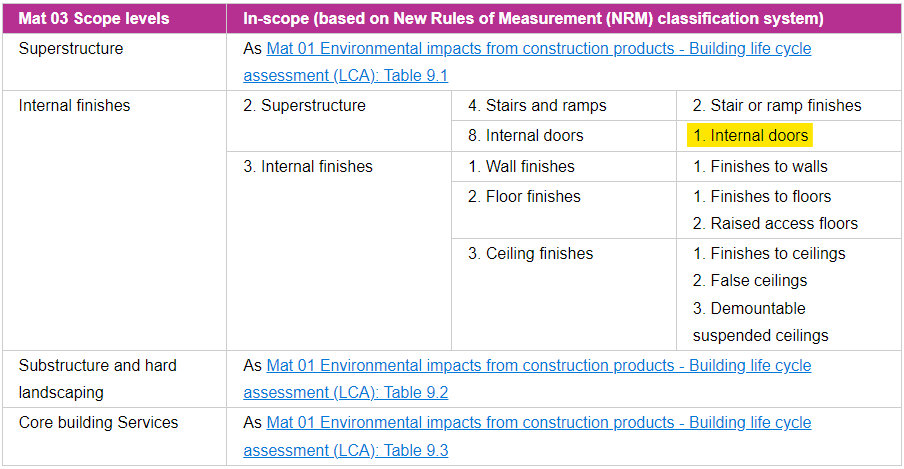 This will be corrected in future versions.